
Introduction
When a gated community connects multiple buildings, one of the earliest architectural questions is where the network’s major functions should live. Should routing, security policy, monitoring, and services remain concentrated in one primary location, or should more responsibility be distributed among individual buildings?
The answer affects fiber pathways, equipment-room requirements, outage impact, troubleshooting, security enforcement, vendor capability, and future expansion. It also influences how easily the community can understand and support the network after the original installation team is gone.
This is not simply a choice between one large switch and several smaller ones. Centralization and distribution describe how responsibilities are organized across the property. A successful design may centralize some functions, distribute others, and intentionally keep certain services local.
01 Understand What Is Actually Being Centralized
A community network can be centralized in one way and distributed in another. Before comparing models, separate four architectural decisions:
- Physical topology: where the main equipment, fiber pathways, switches, and endpoint connections are located
- Routing architecture: where traffic moves between network segments and buildings
- Policy enforcement: where firewall rules, access controls, and security boundaries are applied
- Service placement: where recording, management, building-control, authentication, and other applications operate
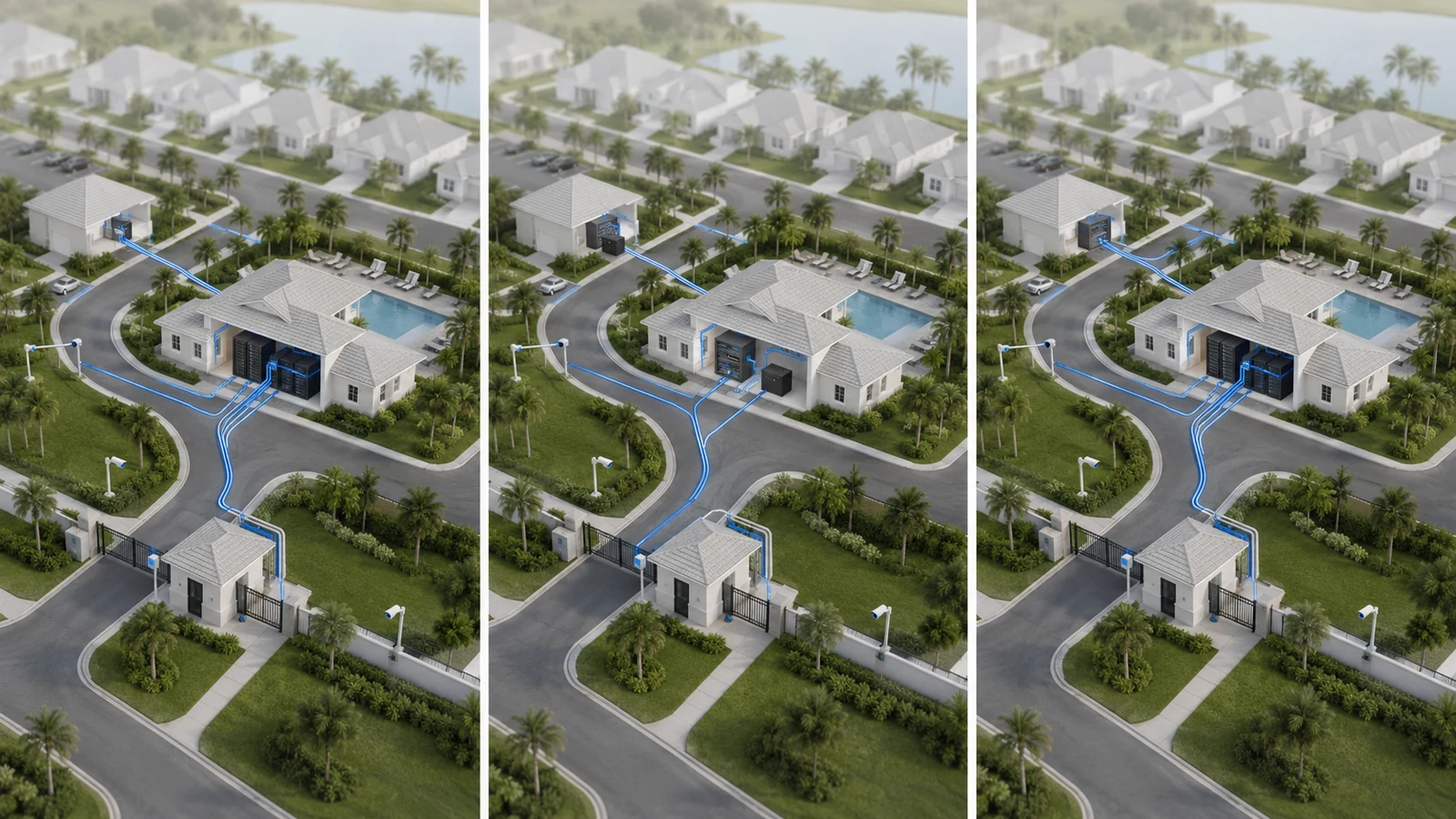
For example, a community may have access switches distributed throughout several buildings while routing and firewall policy remain centralized at the main equipment room. Cameras may connect locally but record to a central system. A gate controller may continue operating locally even if its remote management connection is unavailable.
This means a useful topology conversation cannot begin with “centralized or distributed?” It begins with “Which functions benefit from central control, and which should remain closer to the location they serve?”
For the broader layered structure behind these decisions, review how Community and HOA networks are structured.
02 How a Centralized Community Network Works
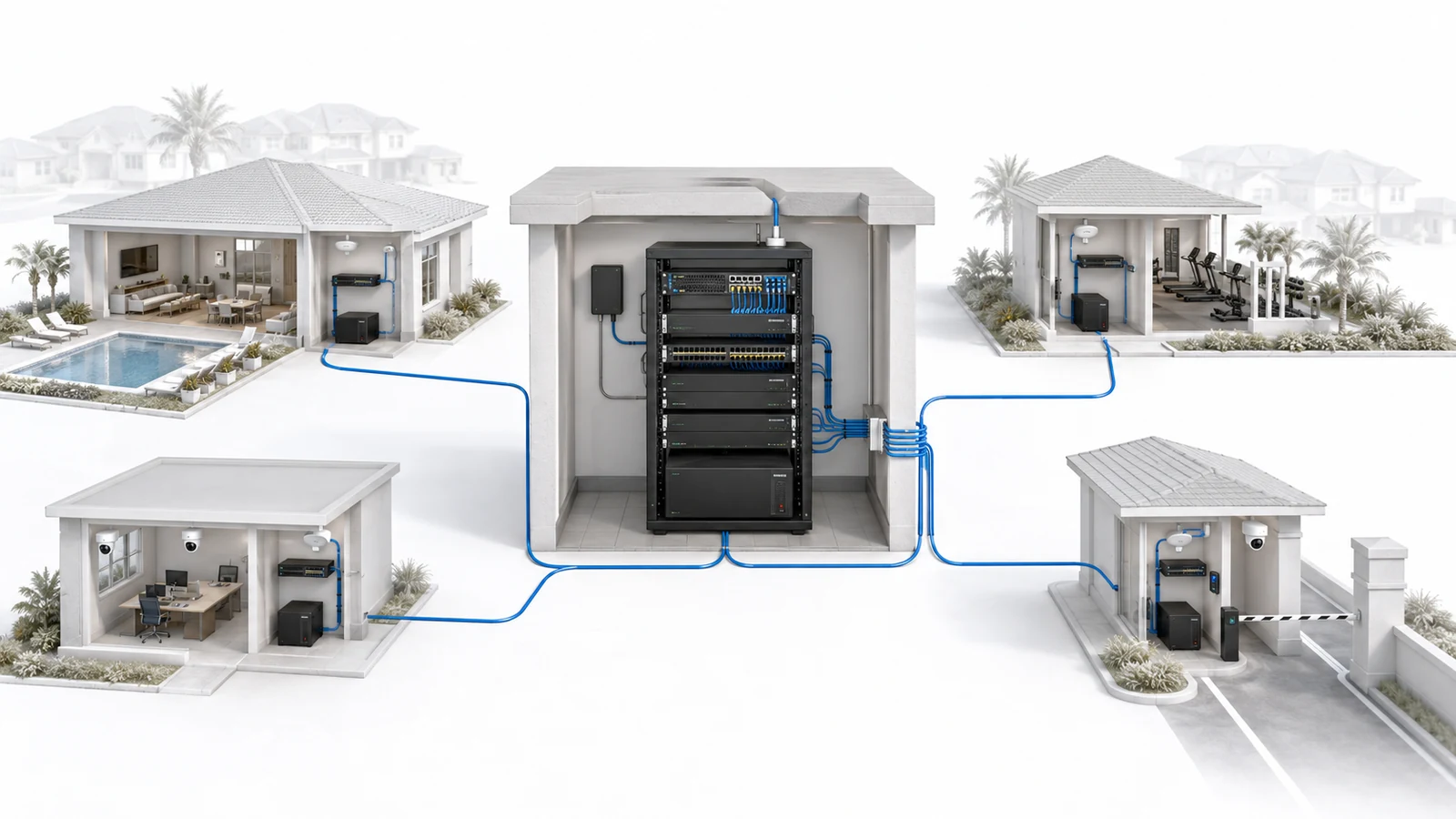
In a centralized model, the primary routing, security, monitoring, and service responsibilities are concentrated in a main network location. This is often an MDF, or Main Distribution Frame, located in a clubhouse, administration building, or dedicated infrastructure room.
Remote buildings normally connect back to this location through a structured backbone. They may still contain local switches, patch panels, UPS equipment, access points, cameras, and controllers. Centralization does not require every endpoint cable to run directly to the MDF.
A typical centralized structure may include:
- Primary and backup internet services terminating at the main location
- A central gateway or firewall
- Core switching and routing
- Major security policies enforced at the core
- Central network-management and monitoring platforms
- Fiber uplinks to building-level switches or IDFs
- Centralized recording, server, or controller systems where appropriate
Traffic within the same local network segment can remain inside a building’s access switch. Traffic that must cross between segments or reach a central service may return through the backbone to the core.
This model can be effective when the community is compact, the primary equipment room is suitable, backbone pathways are dependable, and the support team benefits from keeping most policy and management in one place.
03 Advantages and Limitations of Centralization
The principal advantage of centralization is clarity. When routing, firewall rules, monitoring, and major services remain in one controlled location, the network can be easier to understand and administer.
Potential advantages include:
- Consistent policy enforcement
- Fewer locations containing advanced configuration
- Centralized logging and monitoring
- A clearer path for troubleshooting cross-building traffic
- Concentrated investment in power, cooling, and physical security
- Simpler configuration backup and change management
The same concentration also creates limitations. The primary room may become a large failure domain if many services depend on its power, environment, gateway, core switches, or fiber terminations.
Potential limitations include:
- Heavy dependence on one physical location
- Large numbers of backbone fibers terminating in one room
- Increasing rack, power, cooling, and patching requirements
- Broader outage impact when central equipment fails
- Longer recovery if the primary room becomes inaccessible
- Pressure to route unnecessary traffic through the core
Centralization should therefore be accompanied by an honest review of the room itself. A redundant core does not provide meaningful protection when both switches depend on the same overloaded UPS, unconditioned room, vulnerable fiber entrance, or unprotected electrical circuit.
04 How a Distributed Community Network Works
In a distributed model, individual buildings or property zones receive more local network responsibility. A building-level distribution switch may perform routing, apply access-control policies, or support services that would otherwise reside at the main core.
A distributed structure may include:
- Building-level routing or Layer 3 switching
- Local network segments that do not extend across the entire property
- Local recording or control services
- Independent power protection within each building
- Multiple backbone links connecting building distribution points
- Central management overseeing several semi-independent network zones
Distribution can create clearer building-level fault boundaries. A failed local switch may affect one facility without interrupting unrelated locations. Local traffic can remain within the building, reducing dependence on the core for every communication path.
However, distributed equipment does not automatically create resilience. If every building still relies on one firewall, one internet circuit, one fiber pathway, or one central cloud connection, significant dependencies remain centralized.
A distributed network also requires stronger configuration discipline. Routing, network addressing, policies, software versions, monitoring, backups, and documentation must remain consistent across multiple infrastructure locations.
05 Advantages and Limitations of Distribution
Distribution becomes valuable when a community is geographically spread out, contains several operationally distinct buildings, or needs modular expansion without concentrating every function in one equipment room.
Potential advantages include:
- Smaller building-level failure domains
- Local handling of traffic and services
- Modular expansion as buildings or amenities are added
- Reduced physical pressure on the primary equipment room
- More flexibility when buildings have different operational needs
- The ability to preserve selected local functions during a backbone interruption
The tradeoff is greater operational complexity:
- More locations containing critical equipment
- More UPS systems, environmental conditions, and physical-access points to manage
- More complex addressing and routing
- Greater risk of configuration drift
- More demanding monitoring and backup requirements
- Higher dependence on accurate documentation
- Greater skill requirements for vendors and internal teams
A distributed design can become fragile when each building evolves independently. One vendor configures a different VLAN model, another uses overlapping address ranges, and a third installs equipment that no central team can manage. Distribution must be governed as one architecture even when responsibilities are physically separated.
06 The Hybrid Model: Central Control With Local Distribution
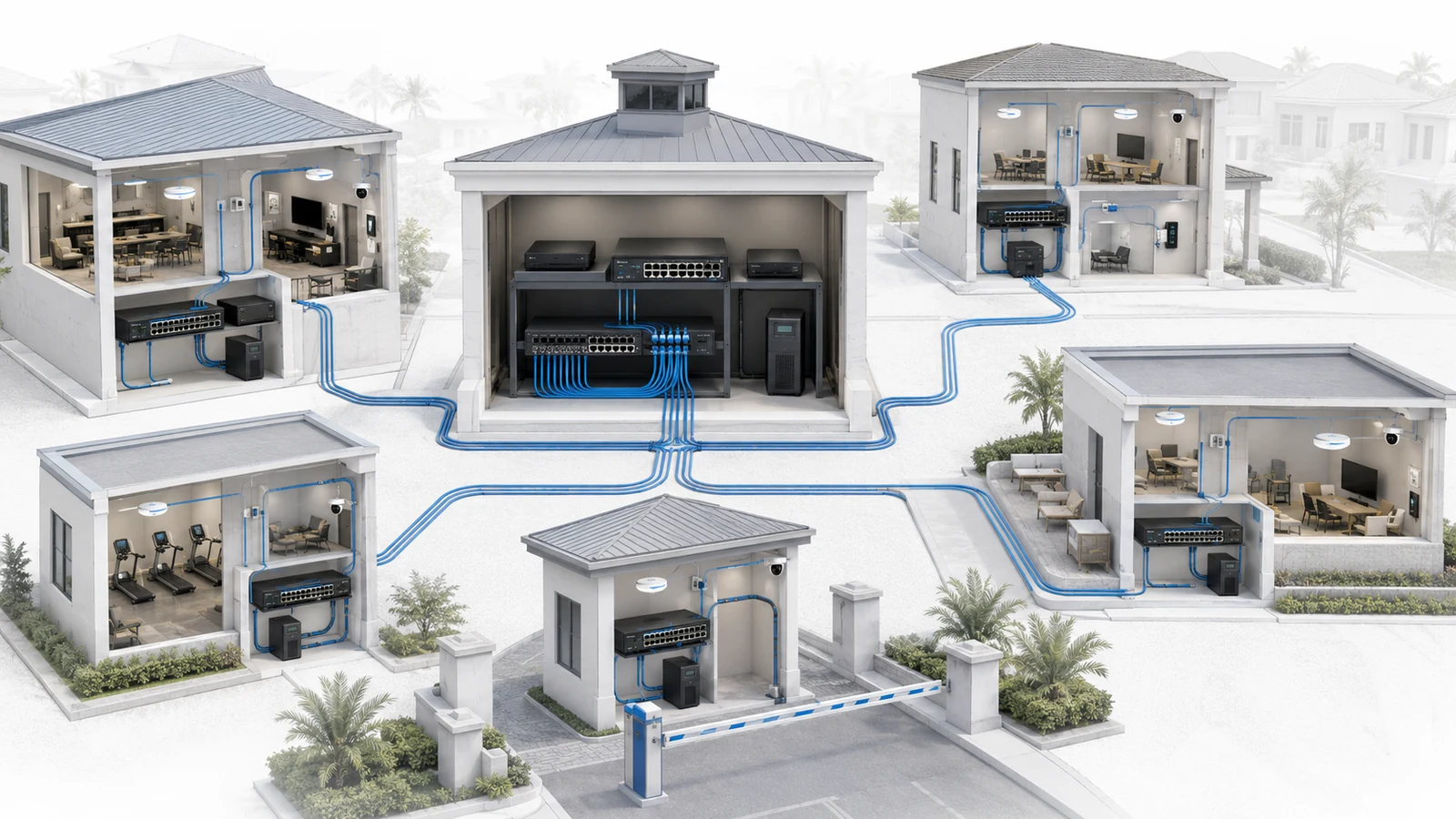
Many communities use a hybrid architecture because different network functions have different requirements.
A hybrid model may centralize:
- Internet services and external security
- Core routing between major trust zones
- Primary network management and monitoring
- Administrative services and configuration backups
- Major recording or application platforms
At the same time, it may distribute:
- Access switching and PoE delivery
- Building-specific wireless coverage
- Cameras, access control, and building-system connections
- Selected building-level network segments
- Local services that must continue during a backbone interruption
- Power protection appropriate to each location
This arrangement can provide central policy clarity while preserving practical building-level distribution. It is especially useful when remote locations have meaningful device counts but do not justify completely independent routing and security environments.
Hybrid architecture is not automatically the correct choice. It can inherit the weaknesses of both models if responsibilities are unclear. A design that routes some traffic centrally and some locally without documentation may be harder to troubleshoot than either a fully centralized or intentionally distributed system.
The architecture should identify exactly where traffic changes segments, where policies are enforced, which services operate locally, and what happens if the backbone or main equipment location becomes unavailable.
07 Compare the Three Models
| Network Model | Characteristics and Advantages | Primary Tradeoffs |
|---|---|---|
| Centralized | Most routing, security policy, monitoring, and major services remain in one primary location. Building switches mainly connect local endpoints and provide PoE. | Simpler control and troubleshooting, but greater dependence on the MDF, backbone, central power, and core equipment. |
| Distributed | Buildings or zones perform more local routing, policy, and service functions. Failures and expansion can be managed in smaller property modules. | Better local autonomy and modularity, but more configuration points, equipment spaces, monitoring requirements, and operational complexity. |
| Hybrid | Internet, major security, and management remain central while access, PoE, selected segments, and appropriate local services are distributed. | Can balance control and fault isolation, but only when central and local responsibilities are clearly documented. |
The comparison should not be reduced to initial hardware quantity. A less expensive centralized proposal may require a larger MDF, denser fiber termination, stronger core equipment, and broader power protection. A distributed proposal may require additional routing-capable switches, UPS units, monitoring, and ongoing configuration management.
Total cost includes:
- Equipment and licensing
- Fiber pathways and terminations
- Equipment-room preparation
- Power and environmental protection
- Configuration, testing, and documentation
- Monitoring and administration
- Future expansion and vendor-transition effort
- The operational impact of foreseeable failures
08 Match the Model to the Property
No reliable rule states that a particular number of buildings requires a centralized, distributed, or hybrid network. The decision should follow the property’s structure and operations.
Important factors include:
- Geography: Are the buildings compact, separated by long pathways, or organized into distant property zones?
- Building function: Does each location contain only a few endpoints, or does it support staff, amenities, cameras, access control, and local operations?
- Service criticality: Which functions must continue during a core, backbone, internet, or building-level failure?
- Backbone design: Are fiber pathways available, protected, documented, and capable of supporting the intended topology?
- Equipment spaces: Can the MDF and IDFs provide suitable power, cooling, physical security, and expansion capacity?
- Growth: Are new buildings, amenities, cameras, access points, or control systems planned?
- Operational maturity: Can the community or its provider support multiple routing points and maintain consistent configurations?
- Vendor continuity: Can a future provider understand, recover, and operate the design?
- Budget: Does the cost evaluation include pathways, rooms, power, monitoring, documentation, and long-term support?
Fiber architecture plays a central role because the physical pathways determine which logical models remain practical. Review fiber versus copper between HOA buildings before finalizing the topology.
Individual shared facilities should also be evaluated as operational zones within the larger model. The guide to clubhouse and shared-space network infrastructure explains how mixed-use buildings affect switching, segmentation, Wi-Fi, and local service requirements.
09 Document the Decision Before Selecting Equipment
Community Topology Decision Checklist
- List every community building, amenity, gate, and infrastructure location.
- Document the systems operating within each location.
- Identify which traffic should remain local and which must cross the backbone.
- Determine where routing between network segments should occur.
- Define where firewall rules and security policies will be enforced.
- Identify services that should remain centralized and those requiring local operation.
- Map the expected impact of an MDF, IDF, backbone, internet, or power failure.
- Review existing and planned fiber pathways between buildings.
- Confirm the available space, power, UPS capacity, cooling, and physical security at each equipment location.
- Assess whether the support team can maintain distributed routing and consistent policy.
- Define monitoring, configuration-backup, documentation, and change-control requirements.
- Compare total lifecycle and operational costs—not only initial equipment quantities.
The topology should be documented in plain language before product selection begins. The decision record should explain which responsibilities are centralized, which are distributed, what remains operational during major failures, and who maintains each layer.
A compact community with one primary clubhouse and a few remote endpoints may benefit from a strongly centralized design. A geographically spread property with operationally significant buildings may need more local distribution. Many communities will land between those positions, centralizing policy and management while distributing access and selected services.
The correct architecture is the one the property can operate, secure, document, and expand. Centralization provides clarity; distribution provides modularity. The strongest design uses each where it creates measurable value rather than treating either model as a universal answer.