
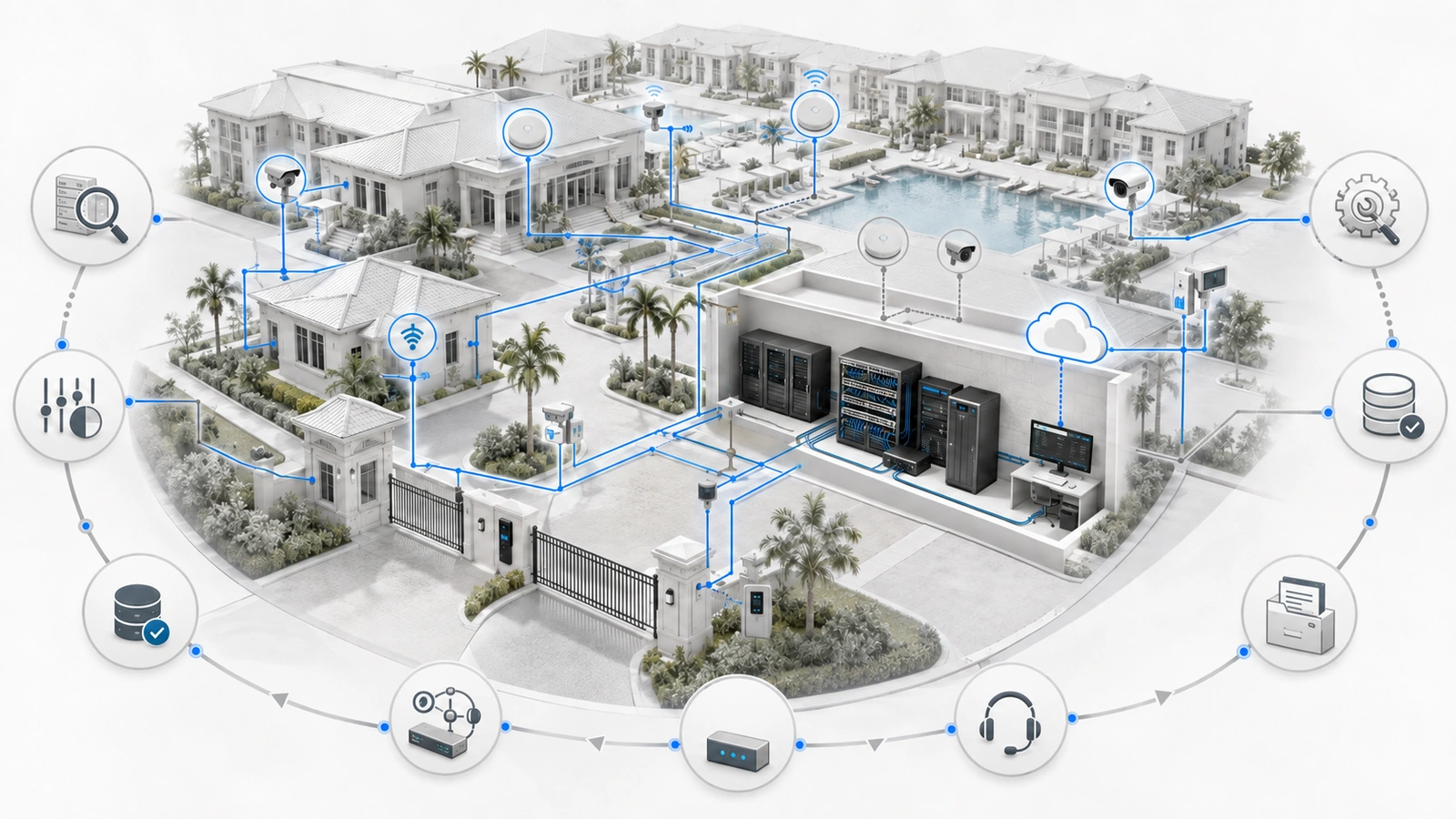
No residential network remains free from disruption forever.
Internet circuits fail, power events affect equipment, configurations change, cloud services become unavailable, hardware reaches the end of its life, and vendors occasionally introduce unexpected consequences during support or maintenance.
In an HOA, condominium, gated community, or shared residential property, the effect may extend beyond internet access. Cameras, gates, intercoms, staff systems, phones, access control, resident services, and building technology may depend on the same infrastructure.
Incident response creates a controlled way to assess what happened, limit impact, coordinate the correct people, restore important services, communicate accurately, and learn from the event.
01 Define What Qualifies as an Incident
An incident is an unplanned event that disrupts service, threatens security or privacy, damages operational capability, or requires coordinated response.
Examples may include:
- Community-wide or location-specific internet outages
- Wireless service failures affecting shared operations
- Gateway, switch, controller, or backbone failure
- Cameras or recording systems becoming unavailable
- Gate, intercom, or access-control connectivity failure
- Power interruptions affecting network infrastructure
- Unexpected configuration changes
- Suspected unauthorized access or compromised credentials
- Vendor remote-access or cloud-platform compromise
- Severe degradation affecting important services
Not every technical event requires the incident process. A routine request to connect a printer, an isolated user question, a planned maintenance window, or a known informational alert may follow a normal support or change procedure.
The boundary should be defined so staff know when ordinary support must become coordinated incident response.
If an event involves immediate danger, fire, crime, medical risk, an active physical-security threat, or another life-safety concern, the appropriate emergency and qualified professional response should take priority over ordinary network troubleshooting.
02 Classify Severity by Operational Impact
Severity should reflect consequence and urgency—not how loudly the problem was reported or which person reported it first.
| Severity | Typical Impact | Response Expectation |
|---|---|---|
| Minor | Limited user, device, or noncritical service with an available workaround | Record, assign, investigate, and resolve through normal support |
| Moderate | Shared amenity, department, building area, or important service affected | Coordinate response, assess dependencies, notify operational owners, and track restoration |
| Major | Multiple locations, many users, significant security concern, or critical operational disruption | Activate incident leadership, vendor escalation, containment, communications, and frequent status review |
| Critical | Severe property-wide impact, active compromise, significant safety or security consequence, or uncontrolled escalation | Immediate coordinated response with executive, emergency, legal, insurance, regulatory, or specialist escalation as appropriate |
Classification should consider:
- Systems, locations, and users affected
- Safety, physical-security, privacy, and financial implications
- Availability of manual or technical workarounds
- Whether the event is contained or still expanding
- Expected duration and restoration uncertainty
- Sensitivity of potentially exposed information
- Provider, vendor, contractual, or regulatory obligations
Severity can change as new evidence becomes available. An isolated access-control communication issue may be upgraded if it begins affecting several entrances or reveals unauthorized administrative activity.
03 Establish Response Roles Before an Incident
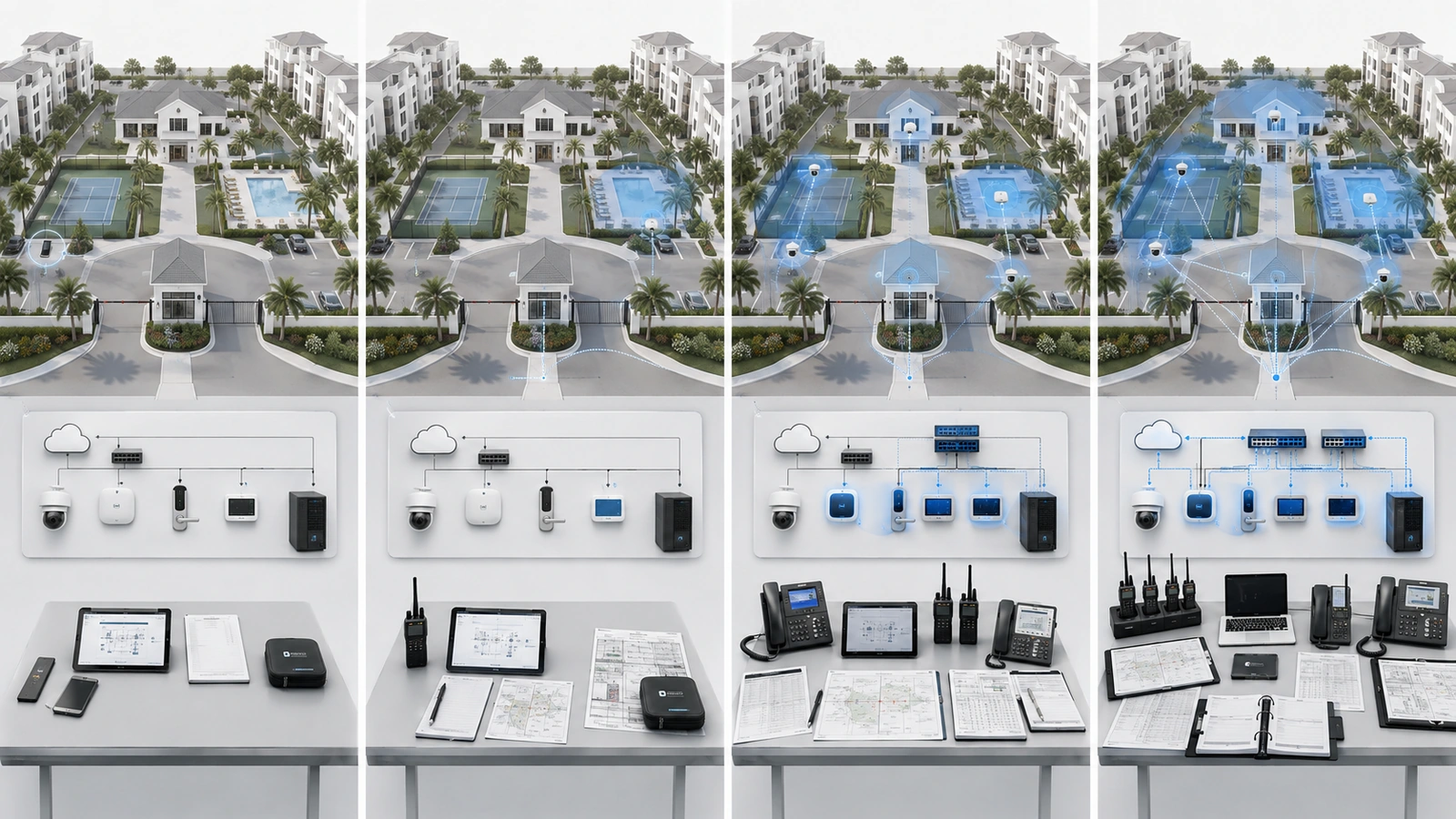
An incident becomes harder to manage when several people contact vendors, restart equipment, or send updates independently.
The response plan should identify:
- Incident coordinator: maintains the overall record, priorities, assignments, and status
- Technical lead: directs diagnosis, containment, recovery, and validation
- Operational owner: explains service consequences and approves operational workarounds
- Communications owner: provides consistent stakeholder updates
- Vendor coordinator: manages third-party escalation and tracks commitments
- Decision authority: approves disruptive containment, emergency changes, spending, or extended outages
A small property may combine these responsibilities in one or two authorized people. The objective is not to create titles; it is to prevent conflicting action and unclear authority.
The contact plan should include property leadership, technology support, internet providers, security and access vendors, cloud-service providers, electrical support, management representatives, and other relevant specialists.
Contacts should be available through a method that remains reachable when the affected internet, cloud, or phone service is unavailable.
04 Confirm Scope and Preserve Evidence
Initial reports are often incomplete. “The internet is down” may describe a failed access point, one disconnected switch, a DNS problem, a provider outage, or a cloud application failure.
Before making disruptive changes, gather basic facts:
- What was observed, and by whom?
- When was the problem first noticed?
- Which locations, networks, applications, and devices are affected?
- Which related services continue operating?
- Did power, maintenance, vendor work, construction, or configuration changes occur recently?
- What alarms, messages, logs, photographs, or device indicators are available?
- Is the impact stable, intermittent, or expanding?
Record timestamps and observations before indiscriminate restarting where practical. Reboots may restore service, but they can also clear volatile information, change symptoms, interrupt unaffected systems, or make the cause harder to identify.
For suspected security, privacy, fraud, or unauthorized-access events, evidence should be handled carefully. Qualified security, legal, insurance, law-enforcement, or other specialists may need to guide preservation and notification decisions depending on the circumstances.
The initial objective is not to prove a root cause immediately. It is to establish reliable scope and preserve enough information for controlled decisions.
05 Contain the Incident Without Expanding It
Containment limits ongoing impact. It is not the same as fixing the underlying problem.
Possible containment actions may include:
- Disabling a compromised or malfunctioning account
- Isolating an affected device or network segment
- Suspending a vendor remote-access path
- Blocking a confirmed malicious destination
- Moving critical operations to an approved alternate connection
- Using a documented manual procedure
- Restricting nonessential services during reduced-capacity operation
Containment decisions should consider downstream effects. Disconnecting a switch suspected of causing instability may also remove cameras, gates, phones, or wireless service. Disabling a cloud account may interrupt several integrated applications.
When time allows, responders should consult current diagrams and dependency records before isolating shared infrastructure.
Emergency technical changes should be authorized at the appropriate level and recorded. The compressed process is described in How to Create a Simple Network Change Management Process.
06 Coordinate Vendors Through One Incident Record
Complex incidents may involve an internet carrier, managed network provider, camera company, access-control integrator, cloud platform, electrician, and property staff.
One incident record should track:
- Vendor case and escalation numbers
- Contact times and responsible representatives
- Information and evidence provided
- Actions requested and performed
- Configuration or access changes
- Provider findings and restoration estimates
- Next commitments and follow-up times
The incident coordinator should prevent several parties from making conflicting changes independently.
If a provider reports that its service is restored, internal infrastructure and dependent applications must still be tested. Likewise, a cloud platform reporting normal status does not prove that the property’s local configuration, authentication, or integration has recovered.
Vendors should receive only the access required for response. Emergency access should be recorded, reviewed, and removed or formalized after the incident.
Third-party access controls are covered in Vendor Access and Third-Party Network Risks in HOA Networks.
07 Communicate Confirmed Information Clearly
Residents and staff do not need every technical detail, but they need accurate operational information.
An incident update may include:
- The services or locations known to be affected
- When the disruption was identified
- Whether the cause is known or still under investigation
- Which providers or specialists are responding
- Available workarounds or temporary procedures
- When the next update will be issued
- How restoration will be confirmed
Restoration estimates should be attributed to the provider or responsible party and presented as estimates rather than guarantees.
Communications should avoid speculation, blame, unnecessary security detail, personal information, or claims that cannot be verified. Different audiences may require different levels of information.
A simple update might state:
The clubhouse internet and guest Wi-Fi are currently unavailable. The issue has been escalated to our network support provider and internet carrier. Other community systems are being evaluated separately. The next update will be provided by 3:00 p.m. unless material information becomes available sooner.
The communications plan should not rely solely on the affected system. If internet-based email, phones, resident applications, or cloud platforms are unavailable, an alternate channel may be required.
08 Recover and Validate Complete Operations
Recovery restores affected systems. Validation confirms that the property has returned to an acceptable operating state.
Depending on the incident, validation may include:
- Primary and backup internet connectivity
- Gateway, DNS, routing, switching, and wireless operation
- Staff, resident, guest, and operational networks
- Camera recording, live viewing, alerts, and retention
- Gates, access control, intercoms, and remote administration
- Phones, management systems, printers, and cloud platforms
- Vendor access and monitoring integrations
- Configuration persistence after restart
- Queued events, recordings, messages, or synchronization
- Removal or documentation of temporary workarounds
Recovery should use known-good configurations and approved procedures where available. Systems should not be declared restored solely because one device responds or the provider closes its ticket.
The operational owner should confirm important user-facing functions, while the technical lead verifies infrastructure and dependent services.
Documentation required for controlled recovery is covered in Network Documentation Best Practices for Homes, HOAs, and MDUs.
09 Close, Review, and Improve
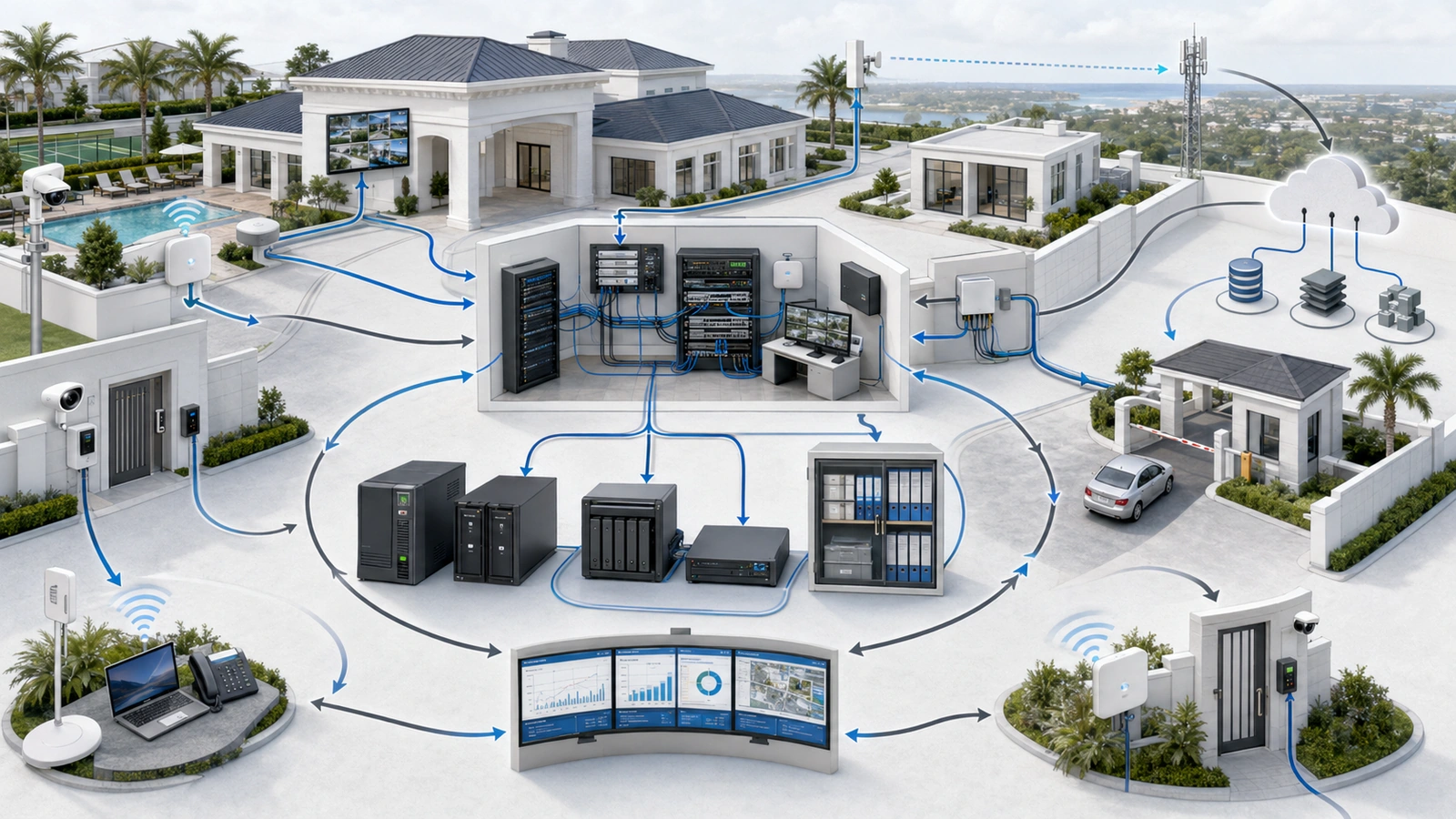
An incident should remain open until the response record, restoration status, temporary measures, and follow-up actions are understood.
Incident Record and Closure Checklist
- Reference: Unique incident number, title, and coordinator
- Timeline: Detection, reporting, escalation, containment, recovery, validation, and closure times
- Scope: Affected users, locations, systems, vendors, and services
- Severity: Initial classification and later changes
- Evidence: Observations, alerts, logs, photographs, messages, and relevant records
- Actions: Troubleshooting, containment, changes, workarounds, and vendor activity
- Communication: Stakeholder updates and external notifications
- Recovery: Restoration actions and validation results
- Cause: Confirmed cause, contributing conditions, or unresolved findings
- Temporary measures: Items to remove, formalize, monitor, or replace
- Corrective actions: Owner, priority, target date, and verification method
- Documentation: Diagrams, inventory, runbooks, backups, contacts, and policy updates
A post-incident review should ask:
- Was the incident detected and classified appropriately?
- Were roles, contacts, and decision authority clear?
- Did containment limit impact without causing unnecessary disruption?
- Were vendors coordinated and their actions documented?
- Did communications remain accurate and timely?
- Were recovery procedures and configuration backups usable?
- Did monitoring and documentation reflect the real environment?
- What technical or operational changes would reduce future impact?
Not every incident has one simple root cause. Reviews should distinguish the initiating failure from contributing factors such as weak documentation, delayed escalation, missing backups, power limitations, uncontrolled access, or unclear ownership.
The objective is improvement, not automatic blame. Corrective actions should be realistic, assigned, tracked, and later verified.
Final Perspective
Incidents cannot always be prevented, but confusion during them can be reduced.
A practical response process helps the property determine what happened, classify impact, establish leadership, preserve evidence, contain the event, coordinate vendors, communicate accurately, restore services, and verify complete operation.
The process should remain proportional. An isolated device problem may require a simple support record. A property-wide outage or suspected compromise may require formal coordination and specialist escalation.
What matters is that responders do not begin from scratch every time.
When roles, records, contacts, decision authority, communications, and recovery procedures are prepared in advance, the property can respond to disruption as an organized operational system rather than a collection of people reacting independently.