
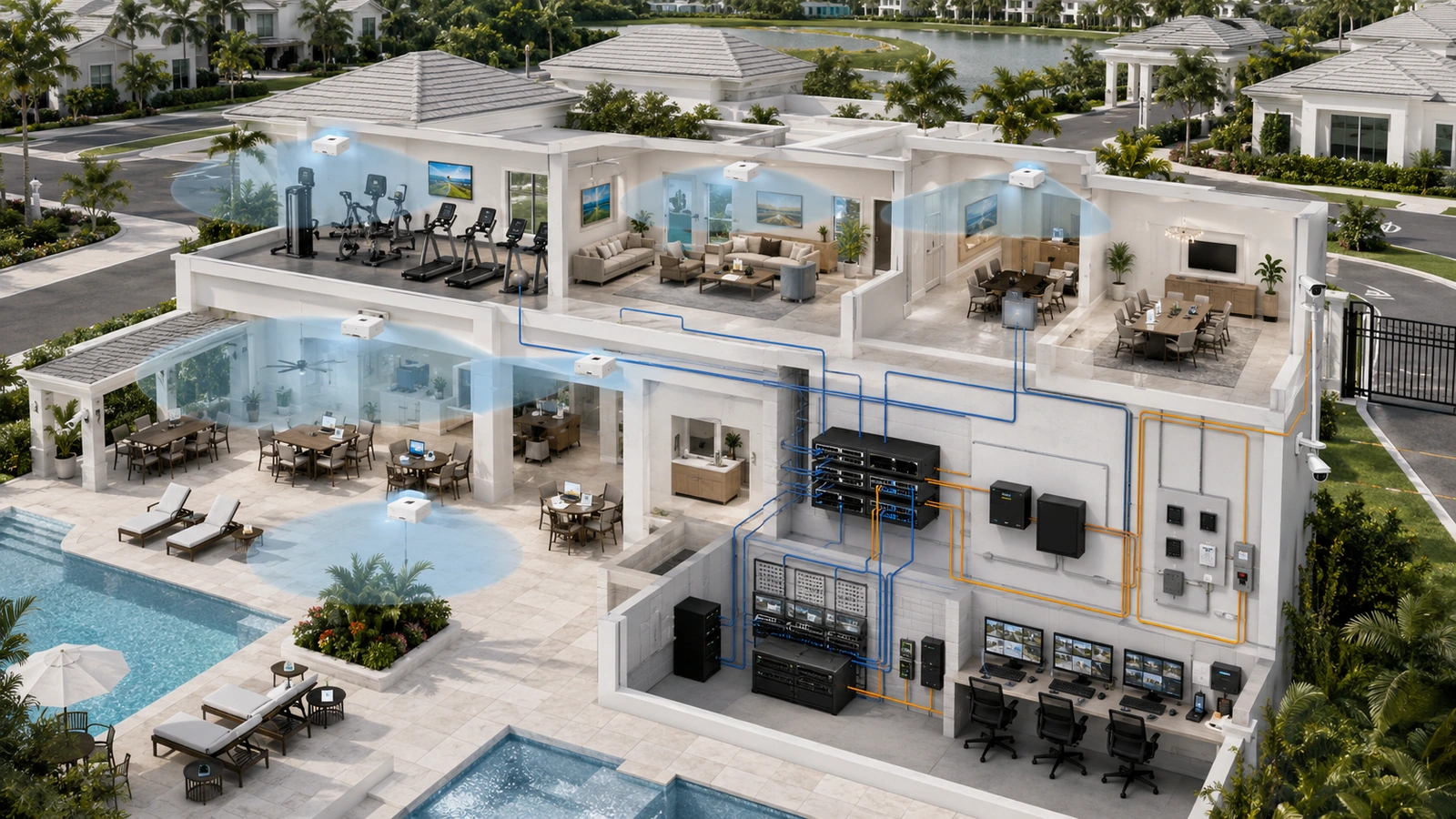
Guest Wi-Fi has become a normal amenity in clubhouses, pools, fitness centers, lounges, conference rooms, lobbies, outdoor spaces, and other shared residential environments.
The service may support residents using community amenities, temporary visitors, event attendees, and other authorized users. Without a defined operating policy, however, access can spread beyond its intended audience, performance expectations can become unrealistic, and guest traffic may be handled too casually around critical property systems.
A guest-network policy should make the service convenient without treating it as uncontrolled connectivity.
The policy defines who may use the service, what it is intended to provide, how users are onboarded, which systems remain isolated, what operational monitoring occurs, and how problems or misuse are handled.
01 Define the Service and Its Intended Users
The term guest network can be misleading because many community guest networks are used regularly by residents rather than only by outside visitors.
The policy should define its intended audience explicitly. Depending on the property, access may be available to:
- Residents using shared amenities
- Residents’ temporary visitors
- Registered clubhouse or event guests
- Prospective residents during approved activities
- Short-term occupants where authorized
- Event attendees
- Other users approved by management
The service purpose should also be clear. It may provide general internet access in designated community spaces, but it may not be intended to replace internet service inside individual residences or provide guaranteed business connectivity.
The policy should state where service is offered, when it is expected to be available, who administers it, and whether access is a complimentary convenience, a resident amenity, or part of another defined service.
Those distinctions influence capacity, support expectations, enforcement authority, privacy notices, and continuity planning.
02 Separate Guest Traffic From Property Operations
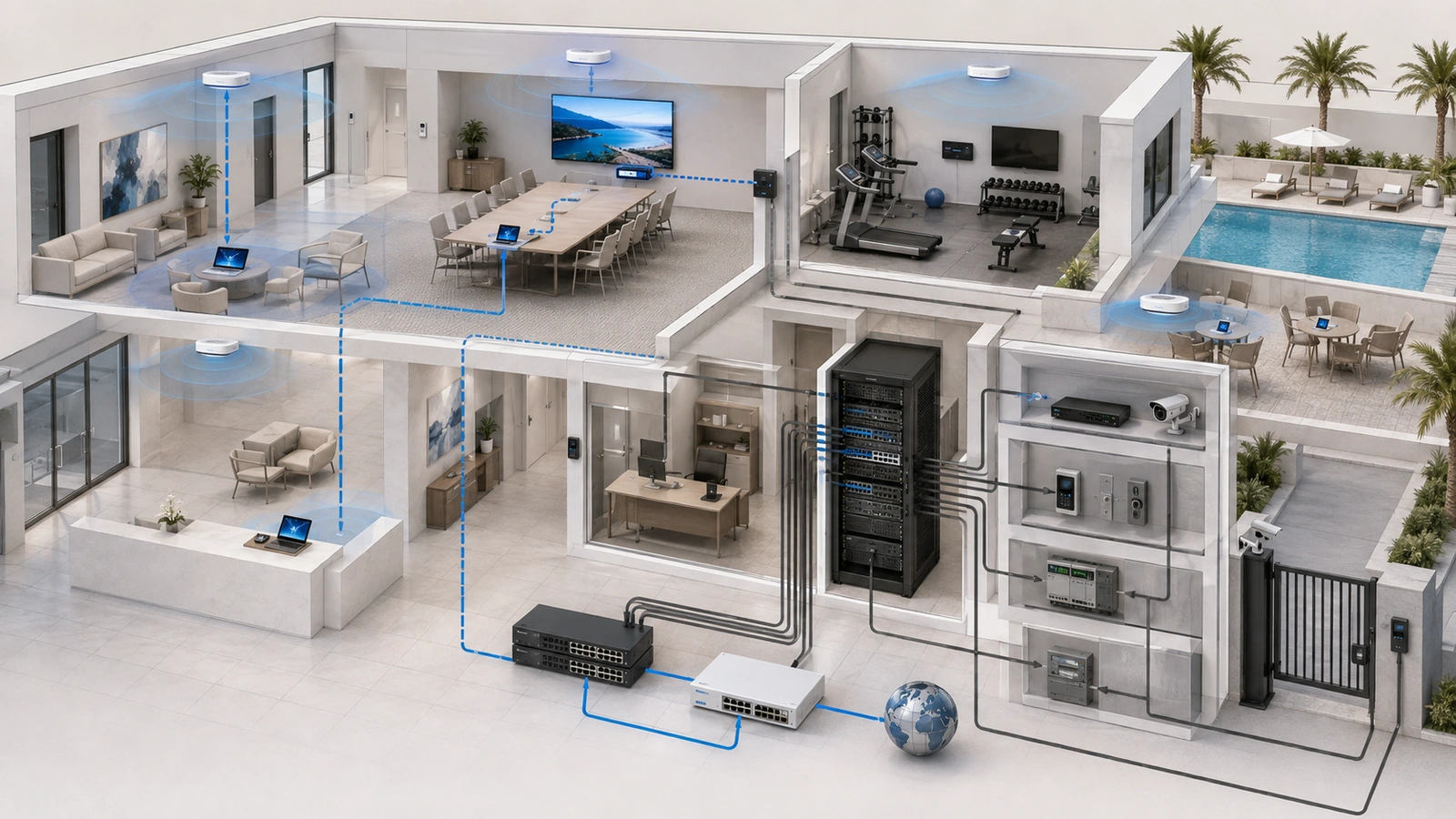
Guest users should not receive unrestricted access to staff systems, infrastructure administration, surveillance, gates, access control, printers, resident records, building controls, or other operational services.
Separation may involve:
- A dedicated network segment
- Firewall policies limiting guest traffic to approved external services
- Wireless client isolation where appropriate
- Restrictions on infrastructure-management interfaces
- Separation from staff, administrative, vendor, and operational-device networks
- Appropriate name-resolution and discovery controls
The design should be tested rather than assumed. A separate wireless name does not guarantee meaningful isolation if the underlying network rules still allow access to internal systems.
Guest isolation also does not remove every risk. The property must still maintain access points, gateways, authentication services, software, monitoring, and internet capacity.
User-to-user isolation may be appropriate for public or broadly shared services, but its effect on legitimate functions should be evaluated. Some casting, printing, collaboration, accessibility, or event applications may require a separately designed workflow rather than opening broad access between all guest devices.
03 Choose an Access Method the Property Can Maintain
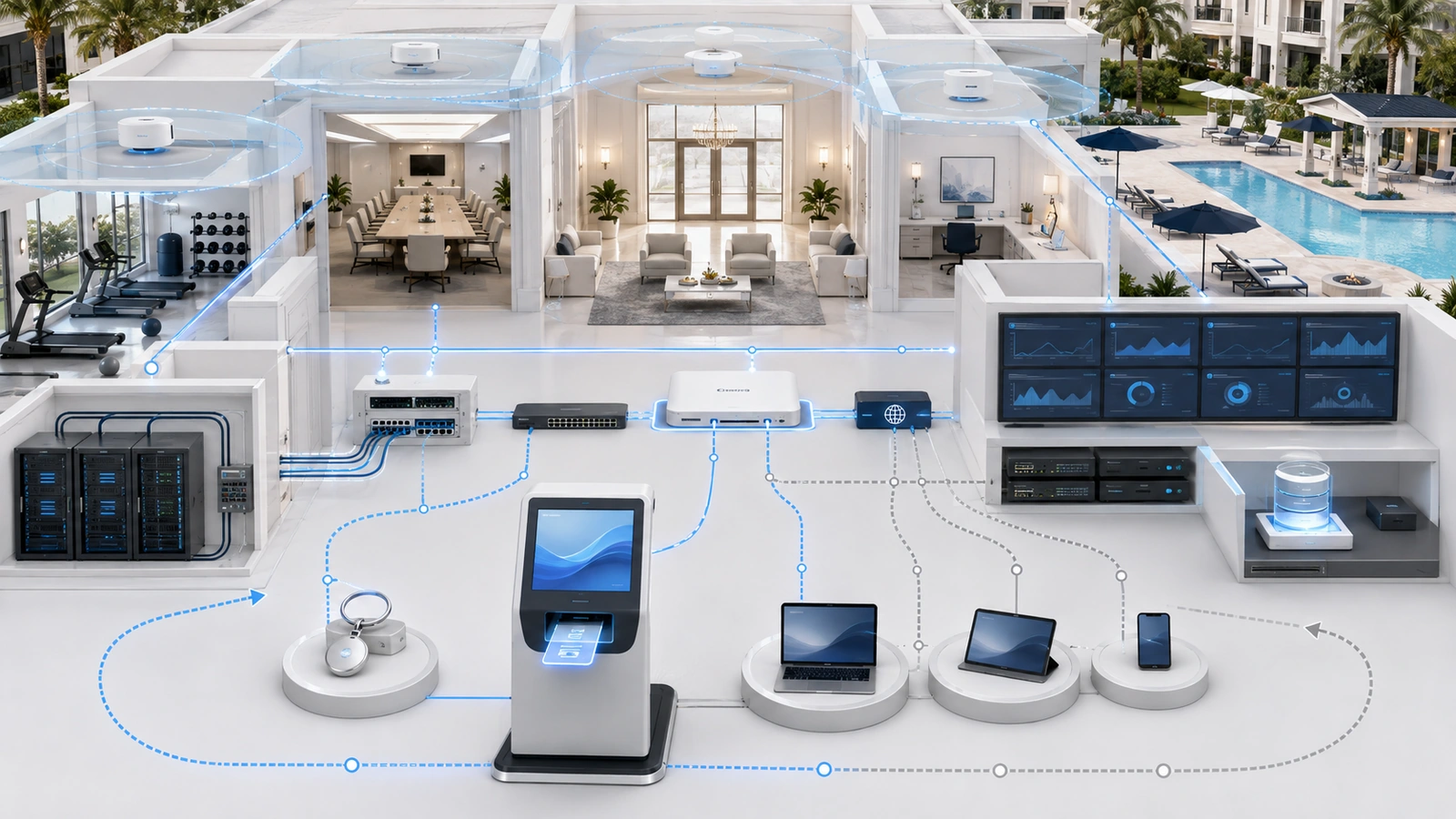
Guest access can be provided through several onboarding models. The correct method depends on property size, turnover, risk, user experience, and administrative capability.
| Access Model | Operational Advantage | Management Consideration |
|---|---|---|
| Shared passphrase | Simple and familiar | Can spread widely and requires coordinated replacement when control is lost |
| Rotating event credential | Limits long-term reuse after an event | Requires reliable distribution and timely expiration or replacement |
| Voucher or temporary code | Supports defined duration and more controlled onboarding | Requires a platform and staff process capable of issuing access |
| Captive portal | Can present terms, notices, or onboarding instructions | Adds platform, accessibility, privacy, and support considerations |
| Resident or sponsor-based access | Connects access with an authorized resident or account | Creates identity, support, privacy, and account-lifecycle obligations |
Password rotation should not be performed according to an arbitrary schedule if the process creates more confusion than control. Credentials should be changed when access has spread beyond the intended population, after certain events or transitions, when compromise is suspected, or according to an approved operational model.
Temporary credentials or automatically expiring access may be preferable for high-turnover events. A stable resident-amenity network may use a different method.
Access instructions should be easy to find without exposing credentials publicly beyond the intended audience.
04 Set Reasonable Use and Performance Expectations
Shared guest service has finite wireless airtime, internet capacity, and support resources. The policy should communicate realistic expectations without promising performance the property cannot guarantee.
It may state that:
- Bandwidth and wireless capacity are shared among users
- Coverage is limited to designated areas
- Performance may vary with occupancy, interference, device capability, and upstream service
- Operational systems may receive priority over guest traffic
- Individual sessions, devices, applications, or traffic categories may be limited where authorized
- The service may be interrupted for maintenance, security, or provider outages
- Users remain responsible for protecting their own devices and communications
Acceptable-use requirements may prohibit unlawful activity, attempts to reach restricted systems, interference with other users, circumvention of controls, unauthorized infrastructure, and activity that materially degrades the shared service.
Rules should be written in plain language and aligned with the property’s actual technical capabilities. A policy should not claim that every prohibited activity can be detected or that service is continuously monitored if that is not true.
05 Plan Capacity for Real Occupancy and Events
A guest network may work well on a quiet weekday and perform poorly during an event, holiday period, fitness class, board meeting, or peak amenity use.
Capacity planning should consider:
- Expected simultaneous users and devices
- High-density spaces and event layouts
- Coverage inside and outside designated areas
- Wireless channel use and interference
- Internet utilization during representative busy periods
- Backhaul and switching capacity
- Guest traffic relative to operational services
- Temporary event requirements
Bandwidth controls can promote fairer use, but they cannot correct poor access-point placement, inadequate backhaul, interference, or insufficient internet service.
Properties should monitor service health, capacity, authentication failures, access-point load, and recurring performance patterns. Monitoring should focus on maintaining the service and protecting the infrastructure rather than inspecting user content unnecessarily.
Repeated complaints should be correlated with time, location, occupancy, and infrastructure data before the property assumes that more internet bandwidth or more access points will solve the problem.
06 Keep Vendors and Operational Devices Out of Guest Access
A guest network may provide temporary internet access for a contractor who needs email or web access while onsite. It should not become the permanent support path for cameras, gates, building controls, audiovisual systems, or other vendor-managed equipment.
Vendors requiring access to supported systems need an approved vendor-access method with defined purpose, scope, identity, duration, and change control.
Likewise, televisions, signage, streaming appliances, sensors, controllers, and other property-owned devices should not be placed on guest Wi-Fi simply because the password is convenient.
Operational devices need:
- An identified owner and purpose
- Appropriate network placement
- Maintenance and update responsibility
- Documented cloud and vendor dependencies
- A support and replacement lifecycle
Guest access should remain a user internet service. Vendor connectivity and operational-device onboarding are separate control processes.
Vendor-specific requirements are covered in Vendor Access and Third-Party Network Risks in HOA Networks.
07 Address Privacy, Monitoring, Retention, and Notice
Guest-network operations may produce logs containing device identifiers, connection times, authentication events, assigned addresses, security alerts, or other technical information.
The property should understand:
- What information its network and onboarding platforms collect
- Why the information is collected
- Who can access it
- How long it is retained
- Whether a vendor or cloud provider stores it
- How it is protected and deleted
- What notice is presented to users
- How authorized requests or investigations are handled
Collecting more information than the property can secure, govern, or justify creates unnecessary responsibility.
Monitoring disclosures should describe actual practices accurately. General language suggesting that the property may inspect everything a user does can create expectations and legal questions that should not be introduced casually.
Terms of use, privacy notices, consent mechanisms, enforcement provisions, and retention periods should be reviewed with qualified legal counsel where appropriate.
If a captive portal is used, the login experience and policy presentation should also be accessible and usable across common devices. Users should not be forced through an unreadable or unnecessarily complicated process to receive basic amenity access.
08 Define Support, Enforcement, and Exception Procedures
Guest Wi-Fi support should have a clear boundary. Staff should know whether they are expected to provide basic connection instructions, create temporary credentials, escalate infrastructure failures, or troubleshoot individual personal devices.
The operating procedure should define:
- How users obtain approved access
- Where service instructions and terms are presented
- What information support personnel collect
- How widespread outages are distinguished from individual-device issues
- Who can suspend a user, device, credential, or service
- How suspected misuse is reviewed
- How exceptions are requested and approved
- How security or operational incidents are escalated
Enforcement should be proportionate, consistent, within the property’s authority, and based on documented evidence rather than assumption.
Immediate suspension may be appropriate when activity presents a credible risk to infrastructure or other users. Other situations may require notification, investigation, or clarification before action is taken.
The property should also define how event organizers, residents, staff, or vendors request temporary capacity, access, or policy exceptions. Approved exceptions should have an owner, purpose, expiration, and technical limitation.
09 Review the Guest Service as an Operational System
The guest network should be reviewed when usage, facilities, occupancy, technology, or policy requirements change.
Guest Network Policy Review Checklist
- Confirm the service purpose, intended users, locations, and availability expectations.
- Verify separation from staff, administrative, vendor, and operational systems.
- Test guest isolation and permitted internet access.
- Review the credential, voucher, portal, or resident-onboarding process.
- Remove expired event credentials and uncontrolled legacy access methods.
- Review coverage, client load, congestion, authentication failures, and peak usage.
- Confirm that operational systems receive appropriate protection and priority.
- Review acceptable-use, privacy, monitoring, retention, and user-notice language.
- Verify support boundaries, escalation paths, enforcement authority, and exception handling.
- Confirm that vendors and property devices use their approved access methods.
- Review accessibility and usability of onboarding instructions and captive portals.
- Record corrective actions, owners, priorities, and target dates.
Policies and technical controls should be reviewed together. A written rule prohibiting access to internal systems is ineffective if the network still permits it. A technically isolated service can still create confusion if users do not understand eligibility, support, or performance expectations.
The guest policy should remain part of the property’s wider network-policy framework. See Basic Network Policies Every HOA or Residential Property Should Have.
Final Perspective
Guest Wi-Fi should be convenient, understandable, and proportionate to the property providing it.
A strong policy defines the audience, purpose, access method, service boundary, acceptable use, privacy practices, performance expectations, support process, and enforcement authority.
Technical separation protects operational systems. Consistent onboarding limits uncontrolled access. Capacity monitoring supports a better user experience. Clear communication prevents the guest network from quietly becoming a service the property never designed or agreed to provide.
The objective is not to make shared connectivity difficult. It is to provide it responsibly without introducing unnecessary operational, security, privacy, or support burdens.