
Introduction
A technically correct network proposal can still fail when an HOA board cannot clearly identify the problem, compare the options, understand the cost, or determine what it is being asked to approve.
Board members are not simply evaluating routers, switches, fiber, cameras, or access points. They are deciding whether a proposed project addresses a documented community need, represents responsible use of association funds, and can be implemented without creating unmanaged risk.
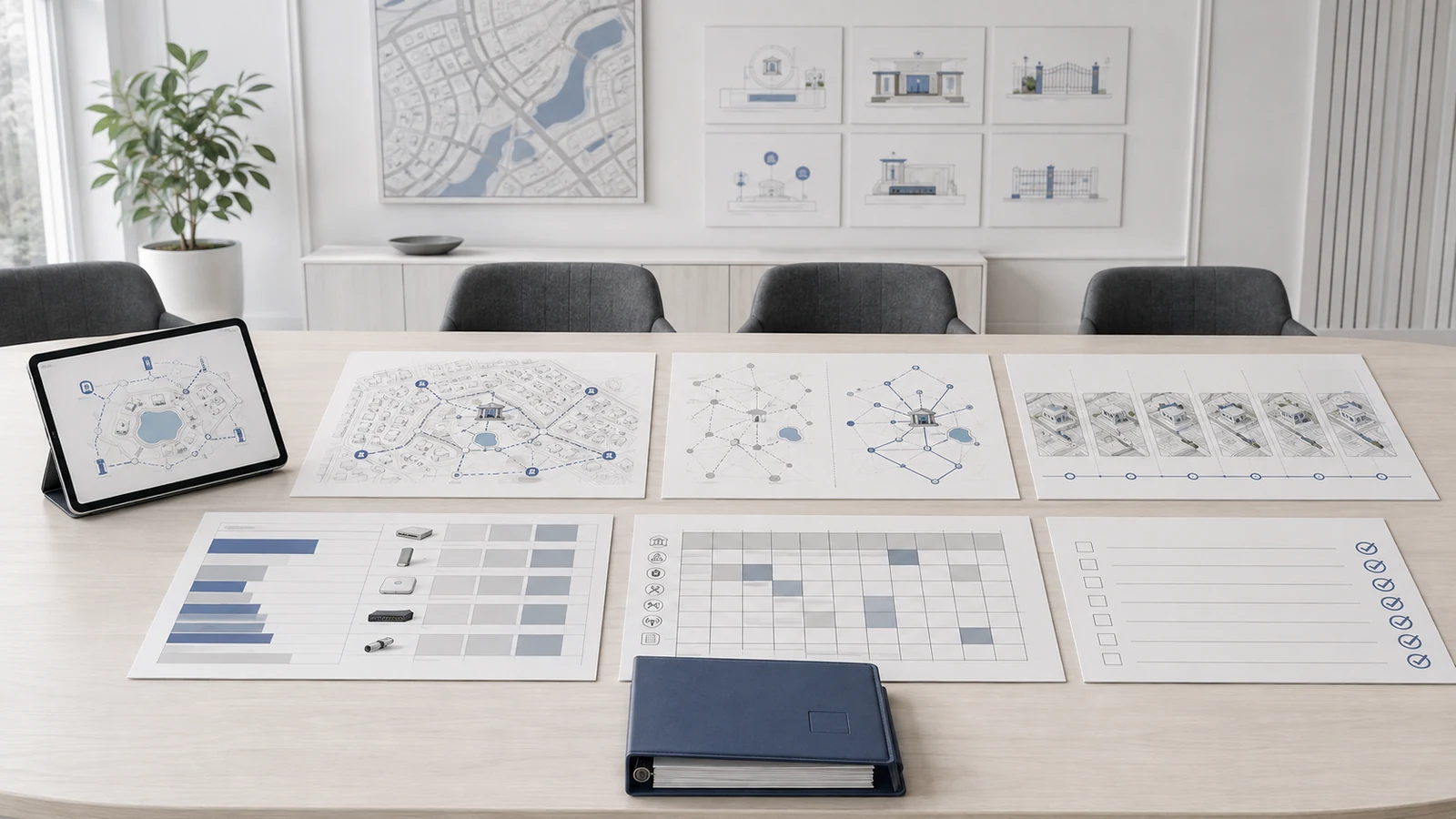
A strong presentation therefore translates technical findings into a decision package. It explains what is happening, why it matters, what alternatives exist, what each option costs, who will be responsible, and how the community will know the project succeeded.
01 Begin With a Documented Community Problem
A proposal should not begin with a product recommendation. It should begin with a concise problem statement supported by observable evidence.
Potential symptoms include:
- Repeated Wi-Fi complaints in specific shared areas
- Cameras disconnecting or failing to record consistently
- Gate, door, or amenity-access interruptions
- Unreliable building-to-building connectivity
- Insufficient network capacity during events
- Recurring service calls without a durable correction
- Unsupported or failing infrastructure
- Uncontrolled vendor access or missing administrative ownership
- No current network diagrams, configurations, or recovery information
- Infrastructure unable to support an approved renovation or amenity project
Evidence may include service tickets, outage records, equipment age and support status, photographs, diagrams, configuration findings, coverage observations, test results, invoices for repeated repairs, or documented project requirements.
Separate the symptom from the likely cause. “Residents report slow pool Wi-Fi” is a symptom. Possible causes include poor access-point placement, insufficient capacity, weak backhaul, internet congestion, interference, damaged equipment, or an undefined service area.
A proposal becomes more credible when it avoids claiming certainty before the assessment supports it.
02 Explain the Current Architecture in Plain Language
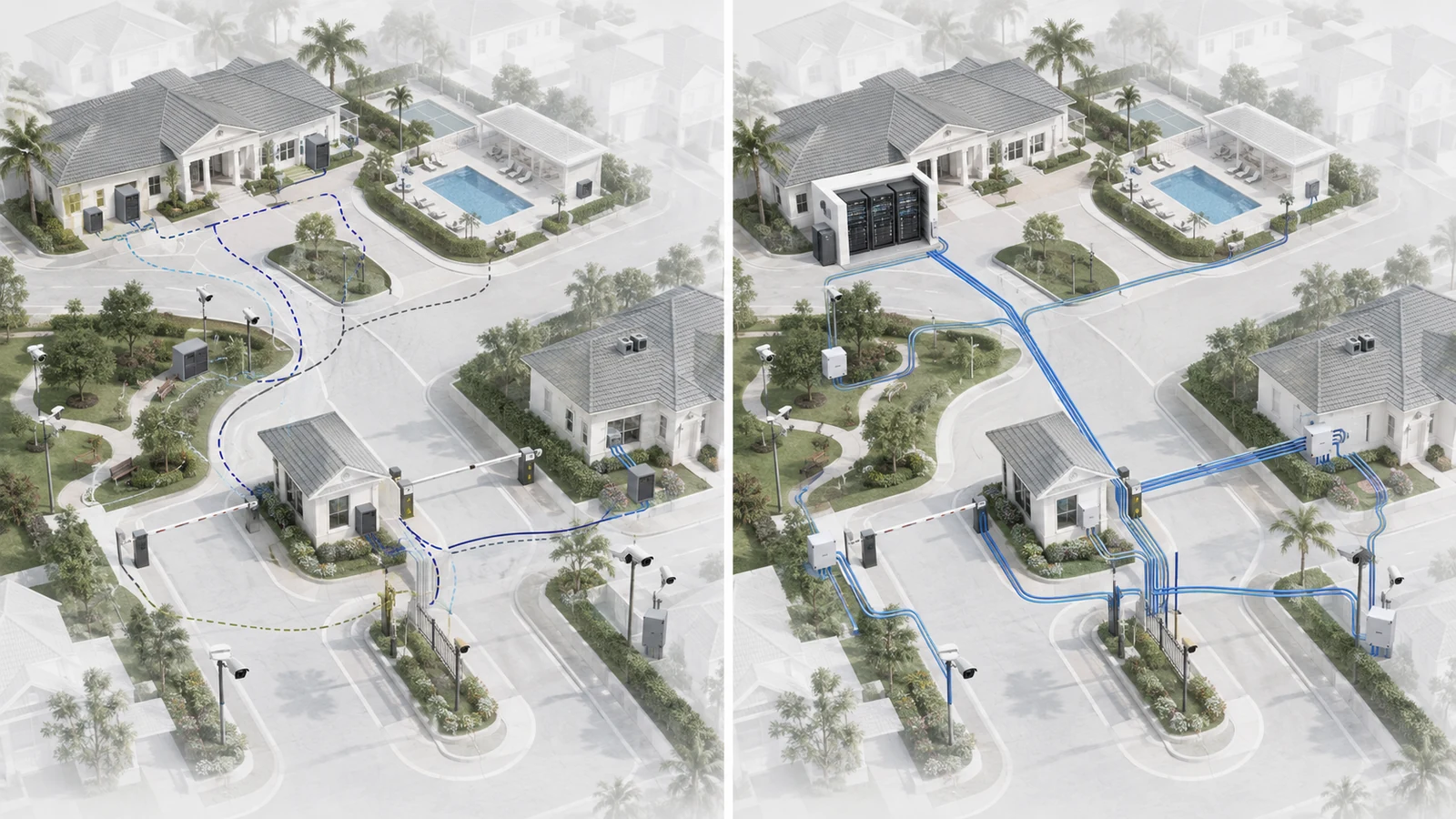
The board needs a simplified view of how the current system is organized and where its limitations sit.
A useful current-state summary might explain:
- Where internet service enters the property
- Where the primary network equipment is located
- How buildings, gates, and amenities connect
- Which services share infrastructure
- Which systems lack separation or documentation
- Where failures have broad operational impact
- Which equipment spaces, pathways, or power conditions require attention
A simple property diagram is often more useful than several pages of model numbers. It can show the clubhouse, gatehouse, amenities, backbone links, equipment rooms, and major service groups on one page.
The presentation should also identify what is working well and will remain in place. A credible assessment does not imply that every existing component must be replaced.
For context on the complete layered model, boards can review how Community and HOA networks are structured.
03 Connect Technical Limitations to Operational Impact
Technical details matter when they explain a practical consequence.
Instead of saying:
- “The core lacks Layer 3 capacity,” explain which segmentation or expansion requirement cannot be supported.
- “The uplink is oversubscribed,” explain which buildings or services experience congestion and when.
- “The network is flat,” explain that public, staff, camera, or operational systems lack appropriate boundaries.
- “The MDF is undersized,” explain the power, cooling, access, safety, or expansion problem created by the room.
- “The copper run is too long,” explain the instability and why the pathway should be reconsidered.
Potential operational impacts include:
- Interrupted resident amenities
- Reduced visibility from cameras
- Slower response during gate or access problems
- Staff productivity interruptions
- Greater dependence on emergency service calls
- Difficulty adding approved systems
- Longer outages because documentation is missing
- Inability to transition providers cleanly
Avoid exaggerating risk. If a condition creates inconvenience rather than a critical operational threat, describe it accurately. Boards make stronger decisions when urgency is supported rather than manufactured.
04 Present Real Options Instead of One Predetermined Answer
A board presentation is stronger when it shows reasonable alternatives and explains their tradeoffs.
Depending on the assessment, options may include:
- Repair and stabilize: correct urgent failures while preserving most of the current architecture
- Targeted improvement: upgrade a specific backbone, equipment room, Wi-Fi zone, or security boundary
- Phased modernization: establish the foundation first and complete later areas according to priority and funding
- Comprehensive replacement: redesign and implement the environment as one coordinated project
- Defer with monitoring: accept the current limitation temporarily while documenting risk and defined review triggers
Each option should explain:
- What it corrects
- What remains unresolved
- Its expected service impact
- The approximate implementation complexity
- Its dependencies
- Its estimated cost
- The circumstances that would force a future upgrade
The recommended option should be identified and justified. The lowest-cost option may be appropriate when the problem is narrow. A larger architectural project may be justified when repeated repairs are preserving a structure that cannot support known requirements.
05 Break the Recommended Project Into Logical Phases
Phasing can make a large project easier to fund and manage, but only when the phases follow technical dependencies.
A practical sequence might include:
- Assessment and documentation: confirm the current architecture, ownership, pathways, configurations, and service requirements.
- Core foundation: prepare the primary equipment location, gateway, switching, power, patching, and management platform.
- Backbone and buildings: correct fiber, conduit, building uplinks, IDFs, and local switching.
- Service separation: organize administration, public access, cameras, access control, building systems, and vendor connectivity.
- Wi-Fi and endpoint improvements: address clubhouse, outdoor, office, event, and operational coverage.
- Validation and closeout: test services, update records, transfer credentials, train responsible staff, and establish ongoing support.
A later phase should not depend on infrastructure that an earlier phase leaves inadequate. Installing new outdoor access points before correcting their backhaul may create new equipment without reliable service.
Each phase should deliver a usable outcome. Avoid leaving the community in an unstable temporary state between approvals.
06 Show the Board Exactly What It Is Buying
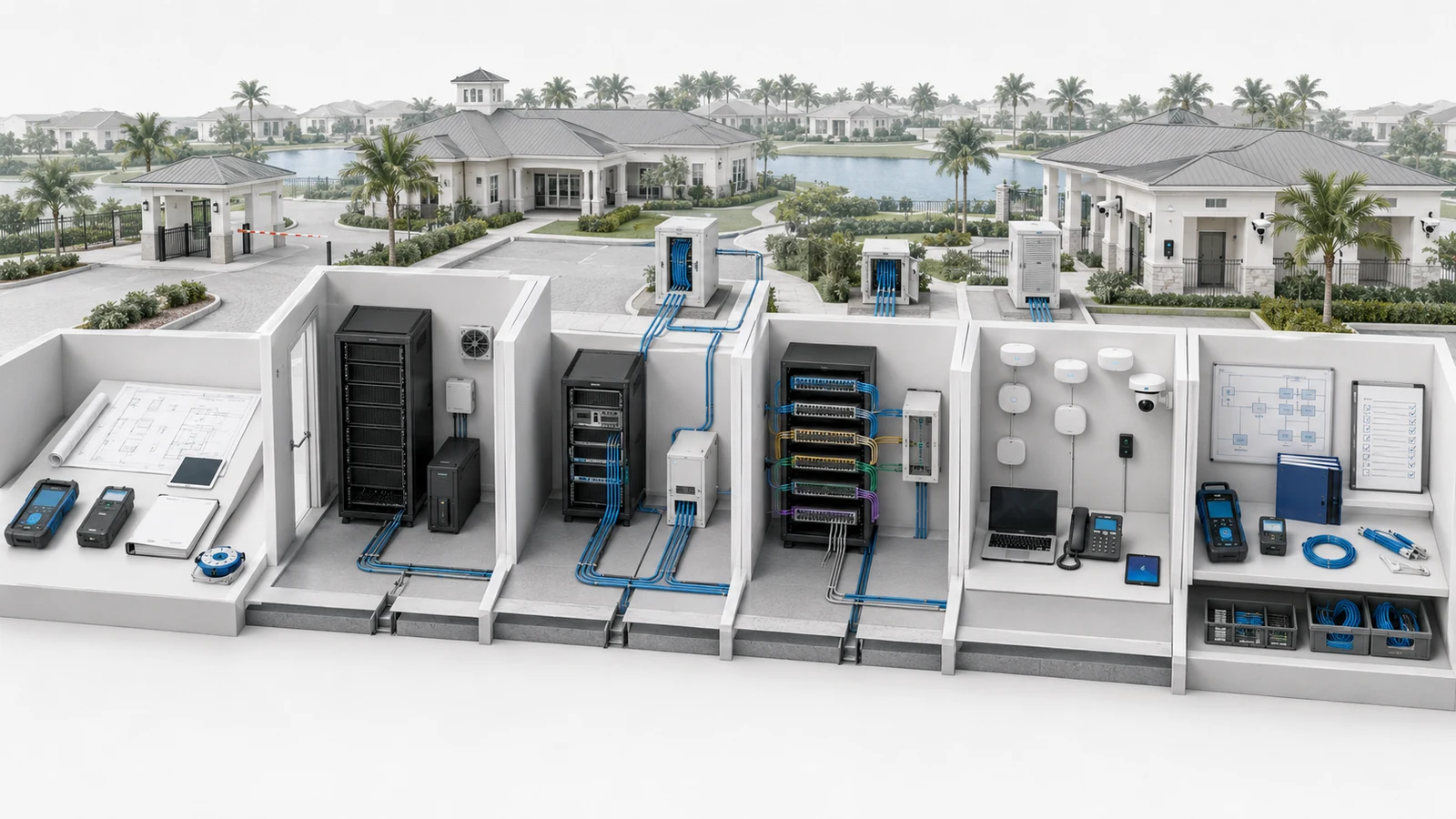
A proposal total is meaningful only when the included and excluded work is clear.
The board package should identify:
- Equipment and quantities
- Cabling, fiber, conduit, and pathway work
- Racks, cabinets, patch panels, UPS systems, and power requirements
- Configuration, migration, and commissioning
- Permits, engineering, electrical, restoration, or construction responsibilities
- Licenses, subscriptions, cloud services, and renewal costs
- Testing and acceptance
- Diagrams, inventories, configurations, and project-closeout records
- Training and operational handoff
- Warranty and post-installation support
- Taxes, shipping, contingency, and assumptions
- Explicit exclusions
Costs should be organized in a way that matches the decision. If the project is phased, show the cost and outcome of each phase. If alternatives are presented, use consistent assumptions so the board can compare them fairly.
Potential cost avoidance should be described carefully. Reduced service calls, fewer emergency repairs, easier vendor transitions, or preserved pathways may provide long-term value, but unsupported savings should not be presented as guaranteed returns.
The cost of deferral should also be evidence-based. It may include continued repair spending, unsupported equipment, inability to complete another approved project, or acceptance of a documented failure risk.
07 Define Ownership, Responsibility, and Control
The board should know who will be responsible before, during, and after implementation.
| Project Area | Decision the Board Should Understand | Required Evidence or Deliverable |
|---|---|---|
| Project Management | Who coordinates vendors, schedule, access, disruptions, and approvals? | Named project lead and responsibility matrix |
| Technical Design | Who is accountable for the complete architecture rather than one subsystem? | Approved high-level design and scope |
| Implementation | Which providers perform cabling, electrical, configuration, installation, and testing? | Vendor scopes, dependencies, and schedule |
| Administrative Control | Who owns accounts, credentials, cloud tenants, licenses, and configurations? | Association-controlled ownership and recovery record |
| Acceptance | Who verifies that required services and documentation were delivered? | Acceptance checklist and signed completion record |
| Ongoing Support | Who monitors, maintains, updates, and responds after installation? | Support agreement, escalation path, and maintenance responsibilities |
Vendor access should be addressed explicitly. The association should understand which providers will retain remote access, which systems they may reach, and how that access will be reviewed or removed. See Vendor Access and Third-Party Network Risks in HOA Networks.
Project completion should include association-controlled administrative recovery, configuration backups, equipment ownership records, warranties, licenses, diagrams, and support contacts.
08 Define Disruption, Testing, and Acceptance Before Approval
A proposal should explain how implementation will affect residents, staff, security, amenities, and vendors.
Disruption planning may include:
- Expected internet or Wi-Fi interruptions
- Gate, door, camera, office, phone, AV, or building-system impact
- Work in occupied community areas
- Access to equipment rooms and vendor-controlled systems
- Construction, conduit, landscaping, ceiling, or restoration work
- Resident and staff communication
- Temporary operations during migration
Acceptance criteria should be defined before work begins. They may include:
- Required buildings and systems connected
- Specified Wi-Fi areas tested
- Critical cameras and access-control services validated
- Primary and backup connectivity tested where included
- Configurations backed up
- Cables, fibers, racks, switches, and endpoints labeled
- Diagrams and inventories updated
- Administrative accounts transferred
- Known deficiencies and exclusions recorded
- Responsible staff provided with support and escalation information
Testing should confirm outcomes rather than simply confirm that equipment powers on. A new access point is not accepted merely because it appears in a controller. The intended coverage area and user experience should be validated. A fiber link should be tested and documented. A segmented network should confirm that permitted traffic works and prohibited access remains blocked.
09 End With a Clear Decision Request
The presentation should conclude with the exact action the board is being asked to take.
The decision request should state:
- The recommended option or phase
- The authorized spending amount or limit
- The funding source, subject to appropriate financial review
- The selected provider or procurement process
- The person authorized to coordinate the project
- Any approval conditions
- The expected reporting and completion requirements
Do not end with “Does anyone have questions?” before making the requested action clear. Questions should be encouraged, but the board must know what decision is on the table.
HOA Network Upgrade Presentation Checklist
- State the community problem in one concise paragraph.
- Support the problem with tickets, observations, tests, photographs, costs, or documented requirements.
- Separate symptoms from verified or likely causes.
- Show a simple current-state diagram.
- Explain operational impact without exaggerating urgency.
- Present reasonable repair, phased, replacement, or deferral options.
- Identify the recommended option and explain why it offers the best fit.
- Break the project into phases that follow technical dependencies.
- Show complete costs, recurring expenses, assumptions, contingency, and exclusions.
- Define project leadership, vendors, administrative ownership, and ongoing support.
- Explain disruption, testing, rollback, documentation, and acceptance.
- Conclude with the exact approval or motion being requested.
The main presentation should remain concise. Detailed equipment schedules, test results, photographs, diagrams, proposals, and specifications can be placed in an appendix for board members who want deeper review.
The strongest proposal does not hide technical detail; it organizes that detail according to the decision. Board members first need to understand the problem, options, cost, risk, responsibility, and expected result. Technical evidence should then support those conclusions.
When a network upgrade is presented this way, it becomes more than a request to purchase equipment. It becomes a documented property decision with clear outcomes, accountable ownership, and a measurable path to completion.