
Introduction
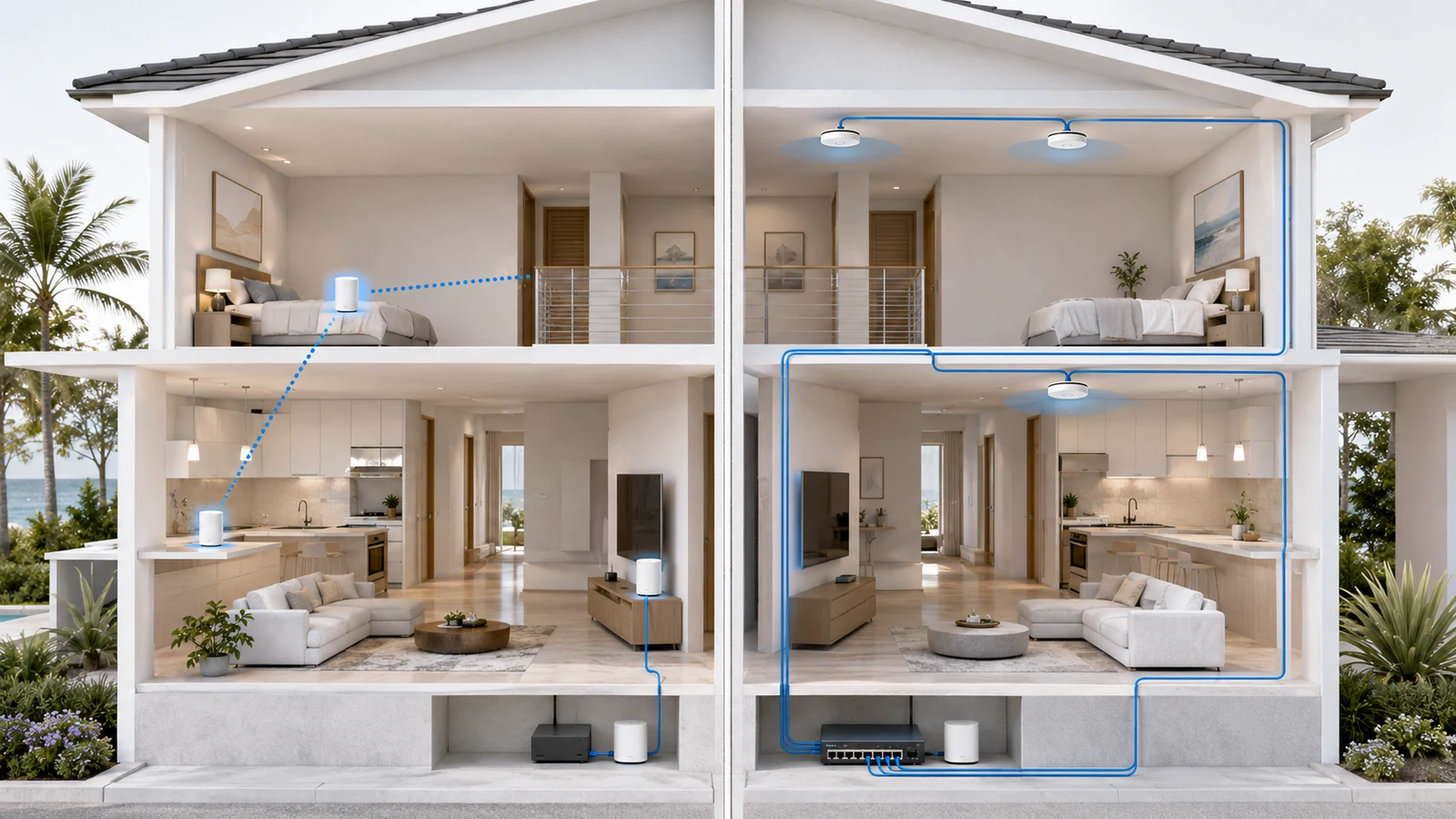
Multiple Wi-Fi units can make two home networks look almost identical. Both may broadcast one network name, allow devices to move between rooms, and appear inside one management app. Yet the way those units communicate with the rest of the network can be fundamentally different.
In a wireless-mesh design, one or more nodes use Wi-Fi for their connection back to the primary node or gateway. In a wired-backhaul design, each access point returns to the network over Ethernet. Some systems can operate either way, which is why the product label alone does not reveal the complete architecture.
Wireless mesh prioritizes installation flexibility. Wired backhaul prioritizes a stable, dedicated network path. Neither description automatically determines whether the finished Wi-Fi will be good or bad—the property, placement, equipment, and expectations still matter.
01 Backhaul Is the Connection Behind the Wi-Fi
When a phone connects to an access point, that is only the first part of the traffic path. The access point must then carry the traffic toward the gateway, local network, or internet. That connection is called the backhaul.
Common residential backhaul methods include:
- Ethernet: Each access point connects by cable to a network switch or gateway.
- Wireless mesh: A secondary node communicates with a primary node or another mesh unit over Wi-Fi.
- Hybrid backhaul: Some nodes use Ethernet while another location uses a wireless connection.
- Alternative existing media: In some properties, suitable coax cabling and compatible adapters can provide a useful wired pathway when Ethernet is unavailable.
- Designed wireless bridge: Separate buildings may sometimes use a dedicated point-to-point link rather than a conventional indoor mesh chain.
The backhaul method matters because every client’s traffic depends on it. A mesh node can display a strong Wi-Fi signal to a nearby phone while still performing poorly if its own upstream connection is weak.
For the broader relationship between backhaul, access points, switching, and the gateway, see the best Wi-Fi setup for large homes.
02 How Wireless Mesh Carries Traffic
A typical mesh system contains a primary unit connected to the network and one or more secondary nodes positioned elsewhere in the home. The nodes coordinate through the same platform, but the details of their wireless backhaul vary.
Some systems use the same radio resources for both client connections and backhaul traffic. Others include an additional radio intended primarily or partly for communication between nodes. Dynamic systems may change how those radios are used according to conditions.
This distinction affects performance, but it does not eliminate the basic limitation of wireless backhaul: the node-to-node connection shares the same physical environment as other Wi-Fi activity. Walls, distance, interference, channel use, and neighboring networks can affect it.
Hop count also matters:
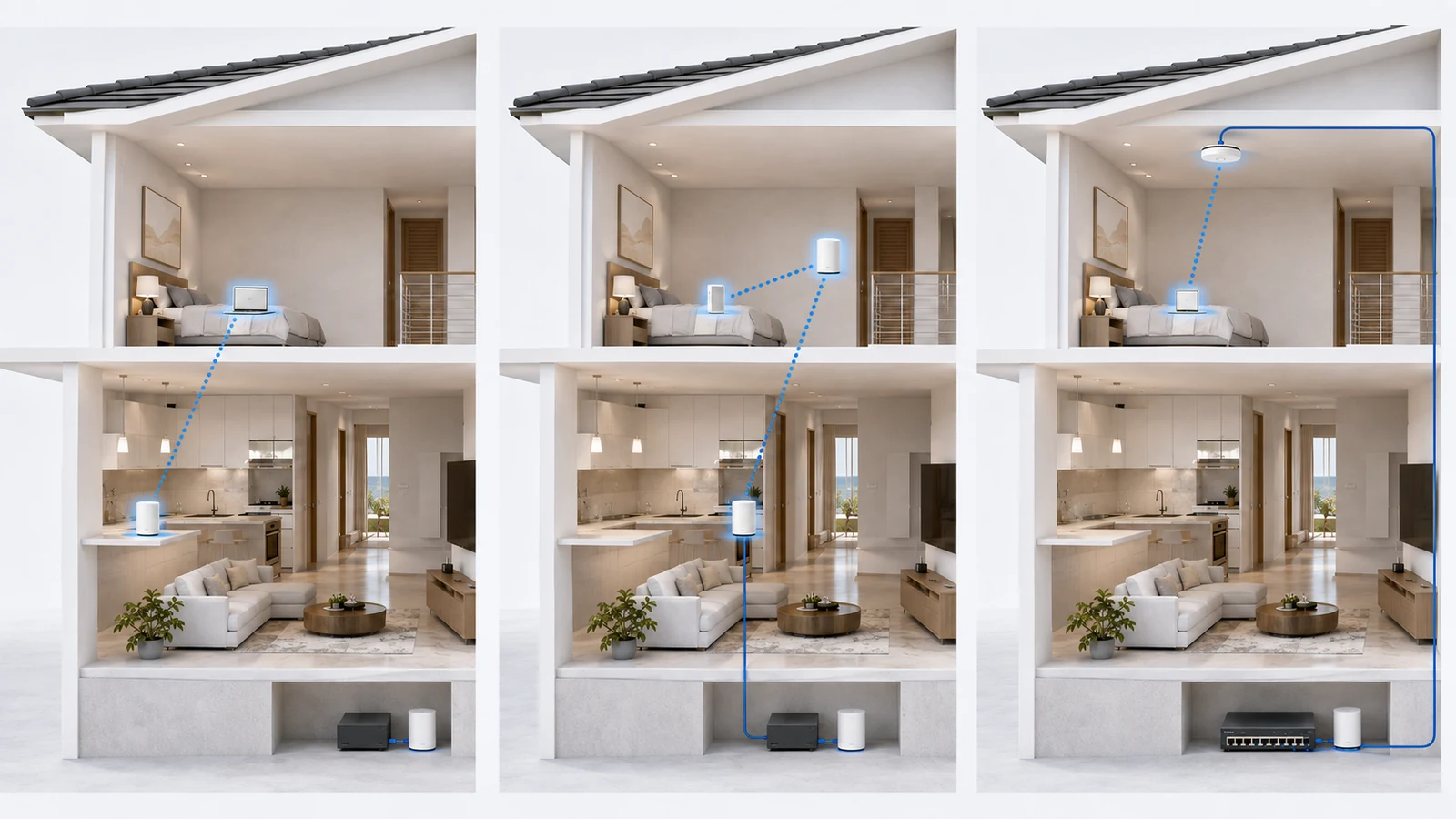
- Single-hop mesh: A secondary node communicates directly with the primary node.
- Multi-hop mesh: Traffic from a distant node passes through another secondary node before reaching the primary connection.
Each additional wireless hop adds another transmission stage and another opportunity for changing radio conditions to affect the connection. This does not produce one universal percentage of speed loss, but multi-hop paths are generally less predictable than a direct wired connection.
03 What Wired Backhaul Changes
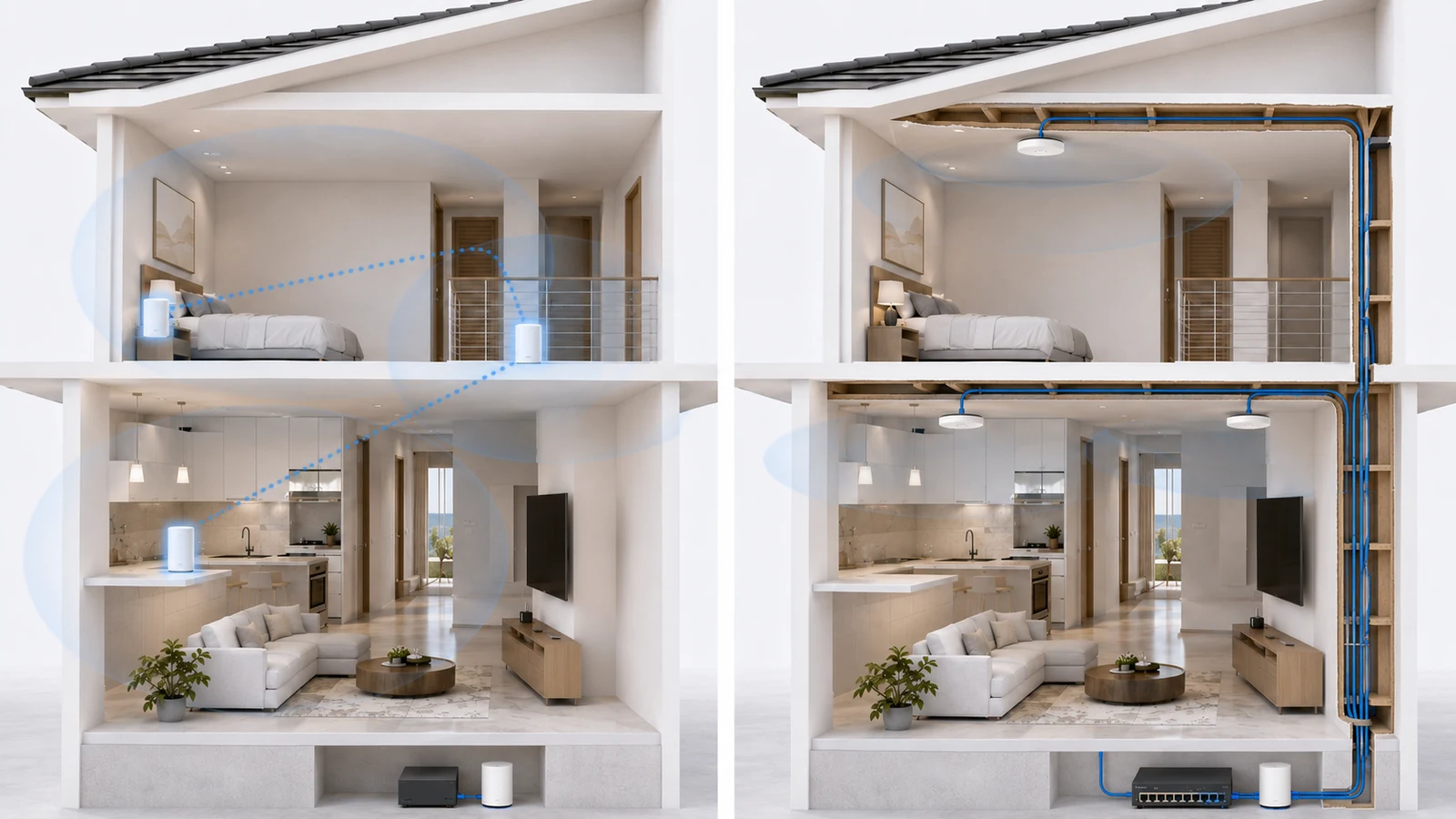
With wired backhaul, each access point has an Ethernet connection to a switch, gateway, or properly designed distribution point. Wireless airtime can then focus on communication with phones, computers, tablets, and other clients rather than also carrying traffic between access points.
Wired backhaul generally provides:
- A consistent link independent of the wireless conditions between access points
- Greater freedom to place access points according to client coverage needs
- Predictable low-latency transport through the wired network
- Simpler centralized power when Power over Ethernet is supported
- A stable foundation for future access-point replacement
- Clearer isolation of wireless problems from backhaul problems
Ethernet does not make the Wi-Fi portion automatically perfect. Poor access-point placement, congested channels, excessive radio power, weak client devices, and badly designed overlap can still create disappointing results.
Wired backhaul removes one important variable: the access point no longer depends on another Wi-Fi connection to reach the network. That is especially valuable in larger, multi-floor, masonry, or performance-sensitive homes.
The permanent cabling should be selected and installed as part of the property’s infrastructure. The guide to the best Ethernet cabling strategy for houses explains how to plan those pathways.
04 Where Wireless Mesh Makes Practical Sense
Mesh is often the most reasonable solution when a home needs broader coverage but installing Ethernet would require extensive demolition, difficult attic work, exterior routing, or other disproportionate disruption.
Wireless mesh can be a strong fit when:
- The home is finished and lacks useful network cabling.
- The owner or tenant cannot modify walls and ceilings.
- The layout allows nodes to maintain strong, preferably direct connections.
- Usage is compatible with the system’s real-world capacity.
- Fast deployment and simple management are priorities.
- The installation is temporary or likely to move.
- The alternative is one poorly positioned router attempting to serve the entire property.
A carefully placed mesh system can be a substantial improvement over a single gateway at one end of the house. The nodes should be positioned between the primary unit and the weak area—not placed deep inside the dead zone where they have little usable signal to relay.
Mesh also works best when the design minimizes unnecessary hops. If a secondary node can communicate directly with the primary unit over a clean path, it begins with a stronger foundation than a chain in which traffic must traverse several rooms and multiple nodes.
Convenience should not be treated as a weakness. Avoiding invasive construction is a legitimate design objective. The question is whether the resulting wireless backhaul can meet the property’s actual expectations.
05 Where Wired Backhaul Provides Greater Value
Wired backhaul becomes increasingly valuable when the network supports important work, entertainment, security, automation, or property operations across a complex environment.
It is normally the preferred approach when:
- Ethernet is already available at suitable access-point locations.
- The home is under construction or undergoing renovation.
- The floor plan includes multiple stories, long wings, or dense materials.
- Access points must be positioned where they cannot maintain a strong wireless link to one another.
- Consistent latency and throughput matter more than installation convenience.
- Outdoor or detached areas need deliberate connectivity.
- The system will support numerous access points or grow over time.
- Centralized PoE power and battery backup are part of the design.
For new construction, omitting access-point cabling usually creates a false economy. The cost and disruption of adding cable after walls and ceilings are finished can be far greater than prewiring suitable locations during construction.
In an existing home, however, cabling cost must be evaluated honestly. A difficult run through concrete, finished ceilings, or inaccessible sections may not be justified for a lightly used area. Architecture should support the homeowner’s priorities rather than force a technically ideal solution at any cost.
06 Compare Performance, Reliability, and Installation
| Decision Factor | Wireless Mesh Backhaul | Wired Backhaul |
|---|---|---|
| Installation | Usually faster and less disruptive; requires suitable power and strong node-to-node placement | Requires Ethernet pathways, termination, switching, and possibly PoE |
| Placement freedom | Node must serve clients while also maintaining an effective upstream wireless connection | Access point can be placed according to the coverage zone wherever appropriate cabling is available |
| Throughput consistency | Varies with interference, obstacles, radio design, link quality, and hop count | Backhaul remains stable while wireless client performance still depends on RF conditions |
| Latency | Wireless hops add processing and transmission time that may vary under load | The switched Ethernet path is normally low and predictable |
| Resilience to RF changes | Backhaul and client connections can both be affected by the wireless environment | RF changes affect client service but not the Ethernet connection behind the access point |
| Power | Secondary nodes commonly need nearby electrical outlets | PoE-capable access points can receive power and data through one Ethernet cable |
| Expansion | Easy to add a node physically, but each addition must have a viable backhaul path | Expansion requires cabling and switch capacity but provides a predictable connection |
| Best general fit | Finished or rented homes where cabling is unavailable and expectations match the wireless design | Prewired, renovated, larger, complex, or performance-sensitive properties |
The strongest choice depends on which tradeoff is more important. Wireless mesh reduces installation difficulty. Wired backhaul reduces dependence on the radio environment between infrastructure devices.
07 Backhaul Does Not Control Roaming by Itself
Roaming is frequently attributed to mesh, but the distinction is more nuanced. In most Wi-Fi networks, the client device plays a significant role in deciding when to leave one access point and connect to another.
A coordinated system can assist through consistent network settings and supported roaming features, but neither wireless mesh nor Ethernet backhaul guarantees seamless transitions in every circumstance.
Roaming behavior is influenced by:
- Coverage overlap between access points
- Transmit-power configuration
- Channel design
- Client-device hardware and software
- The thresholds and assistance features used by the wireless system
- Whether the access points broadcast compatible security and network settings
Wired backhaul can simplify RF planning because the access points do not need to maintain wireless links to one another. However, an Ethernet-connected system can still have sticky clients when access points are too powerful, too close together, or positioned poorly.
Likewise, a well-designed mesh platform may roam effectively when its nodes have strong backhaul links and appropriate coverage relationships. Use the access-point placement blueprint to plan those relationships correctly.
08 A Hybrid Design Can Be the Right Compromise
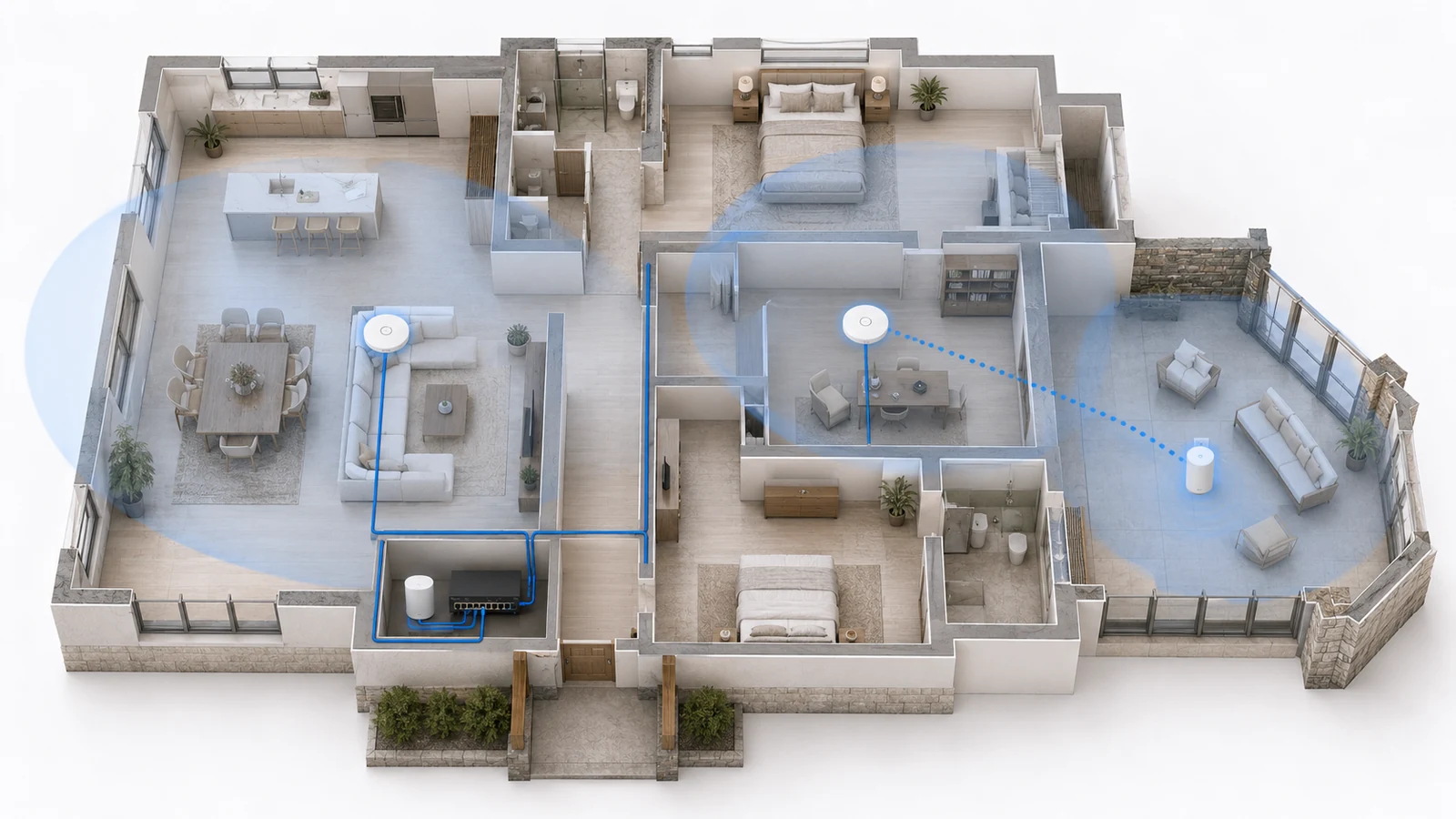
Many properties do not need an all-or-nothing decision. A hybrid network may use Ethernet for the primary indoor access points and wireless backhaul only where cabling is unusually difficult.
For example:
- Two central access points may use Ethernet while a secondary bedroom node uses wireless backhaul.
- A mesh product may initially operate wirelessly and later move to Ethernet backhaul after renovation.
- An existing coax pathway may support an adapter-based wired connection in one difficult room.
- A detached building with clear line of sight may use a dedicated wireless bridge feeding a local access point.
The weaker section of a hybrid system should be documented and evaluated according to what it serves. A wireless node used for casual patio browsing has different requirements from one supporting a full-time office, several cameras, or a media room.
Detached structures require particular care. A conventional mesh node placed inside a metal or masonry outbuilding may not maintain a dependable connection to the house. A buried cable, properly designed fiber link, or purpose-built wireless bridge may be more appropriate.
09 Make the Decision Before Buying the System
Mesh vs Wired Backhaul Decision Checklist
- Identify every indoor and outdoor coverage zone before selecting equipment.
- Check whether usable Ethernet or coax already reaches any proposed locations.
- Determine whether new cabling is practical during construction or renovation.
- Estimate whether mesh nodes can maintain strong direct links without several wireless hops.
- Consider walls, floors, concrete, metal, appliances, and other obstacles between nodes.
- Identify offices, gaming areas, media rooms, and other performance-sensitive zones.
- Decide whether installation simplicity or long-term predictability is the higher priority.
- Confirm that the selected product supports Ethernet backhaul if future cabling is possible.
- Evaluate available ports, link speeds, PoE requirements, and switch capacity for a wired design.
- Consider a hybrid layout when only one or two locations are difficult to cable.
- Avoid placing a mesh node inside the dead zone it is expected to correct.
- Validate the completed network from the important client locations—not only beside the primary unit.
The number of nodes should follow the coverage plan rather than the size of the package sold by the manufacturer. Adding another mesh unit does not help if it introduces a weak multi-hop path or excessive overlap. The guide to how many access points a home needs provides a separate estimation framework.
10 Final Decision: Convenience or Infrastructure
Wireless mesh and wired backhaul solve the same fundamental requirement in different ways: they connect distributed Wi-Fi radios to the rest of the network.
Mesh is valuable because it can improve coverage without opening walls or installing new cabling. In a suitable home with strong node placement, limited hop count, and realistic expectations, it can provide an effective and elegant solution.
Wired backhaul is normally the more durable foundation when the property can support it. Ethernet gives each access point a predictable path, preserves placement freedom, supports centralized PoE, and remains useful through future generations of wireless hardware.
The best design may also combine both. Wire the locations where reliability and performance matter most, then use wireless backhaul selectively where the cost or disruption of cabling outweighs the benefit.
The right question is not whether mesh is good or bad. It is whether the chosen backhaul can reliably support each access point in the environment where it will operate.