

Estimating a technology project requires more than adding the prices of the visible equipment. The complete budget may also include mounting hardware, racks, cabling, installation labor, configuration, testing, documentation, design, shipping, permits, licensing, contingency, and other project-specific costs.
A network switch may cost less than the labor and materials required to install the infrastructure around it. A camera project may include reasonably priced cameras but require expensive pathways, lifts, weather protection, power, storage, and configuration. A wireless project may involve fewer access points than expected while requiring additional cabling, switching, mounting, and validation.
The purpose of an early project estimate is not to produce a guaranteed price before the scope and site conditions are known. It is to make the current assumptions visible, organize the expected cost categories, identify missing information, compare the likely total with the available budget, and prepare for current written quotes.
This guide explains how to create that planning estimate and matches the calculation model used by the free NaplesTechPro Technology Project Cost Estimator.
Key Takeaway
Define the scope before assigning prices. Calculate each item from its quantity and unit cost, separate taxable and non-taxable assumptions, include labor and commissioning, add a risk-appropriate contingency, and compare the planned total with the available budget. Treat the result as a planning estimate—not a contractor quote, bid, or guaranteed final cost.
01 Define the Purpose of the Estimate
Technology projects can be estimated at several stages. The amount of available information affects how confidently the result can be used.
An early estimate may support:
- Initial feasibility discussions
- Budget requests
- Comparison of possible approaches
- Determining whether the project should proceed
- Preparing a request for proposals or contractor pricing
- Separating essential work from optional improvements
- Establishing a preliminary funding range
A later estimate may support:
- Final equipment selection
- Contractor comparison
- Purchase authorization
- Project scheduling
- Change control
- Tracking committed and actual costs
Do not present a conceptual estimate as though it carries the same certainty as a current, site-verified written proposal.
Record the date of the estimate, its intended use, the information available, the source of each price, and the conditions that could change the result.
02 Define the Project Scope
A useful estimate begins with a clear description of what the project is expected to deliver.
The scope should identify:
- The property, building, system, or operational area involved
- The technology systems included
- The required project outcome
- The quantity and location of intended devices
- Existing infrastructure that will remain
- Infrastructure that must be replaced or expanded
- Required installation, configuration, testing, and documentation
- Who will perform each part of the work
- Known constraints and site conditions
- Items explicitly excluded from the estimate
A project called “upgrade the network” is too vague for dependable budgeting. A more useful scope might state:
- Replace the gateway and primary switch
- Add four wired wireless access points
- Install a wall-mounted rack and patch panel
- Terminate and test 16 existing or new cable runs
- Configure the network, wireless service, and required segmentation
- Validate coverage and connected systems
- Label the installation and provide final documentation
The estimate becomes more dependable as quantities, locations, responsibilities, technical requirements, and acceptance criteria become clearer.
Scope Comes Before Price
A lower estimate may simply omit work included in a higher estimate. Confirm that equipment, quantities, labor, configuration, testing, documentation, permits, and exclusions are comparable before evaluating two totals.
03 Record the Planning Assumptions
Every estimate relies on assumptions. Documenting them makes the result easier to review and revise.
Possible assumptions include:
- Existing cabling can be reused
- All proposed cable routes are accessible
- Suitable electrical power is already available
- The existing rack or equipment room has sufficient space
- Work can occur during ordinary business hours
- No lift, trenching, core drilling, or restoration is required
- The selected equipment is available at the researched price
- The client will provide internet service, credentials, or floor plans
- One mobilization or site visit is sufficient
- No asbestos, structural, environmental, or concealed-condition work is included
- Permits or licensed trades are either included or intentionally excluded
- Configuration complexity remains within the described scope
Also document known exclusions, such as:
- Electrical work
- Wall repair and painting
- Ceiling restoration
- Conduit, trenching, or directional boring
- Internet-provider fees
- Recurring subscriptions and licenses
- After-hours work
- Rental equipment
- Engineering or permitting
- Training beyond the stated handoff
- Future support and maintenance
An exclusion is not automatically a problem. The problem occurs when an excluded requirement is discovered after the budget has already been approved.
04 Organize the Complete Cost Structure
The Technology Project Cost Estimator provides eight cost categories:
| Cost Category | Possible Items | Planning Purpose |
|---|---|---|
| Equipment | Gateways, switches, access points, cameras, recorders, UPS systems, servers, displays | Primary active technology |
| Materials | Racks, patch panels, cable, connectors, mounting hardware, enclosures, accessories | Supporting physical components |
| Cabling / installation | Pathways, cable installation, termination, mounting, testing, labeling, site labor | Physical implementation |
| Configuration / commissioning | Setup, programming, integration, migration, validation, documentation, handoff | Making the installed system operational |
| Design / consulting | Site assessment, drawings, system design, specifications, project coordination | Planning and professional services |
| Permits / licensing | Permits, inspections, required professional fees, project-specific licensing | Applicable authorization and compliance costs |
| Shipping / delivery | Freight, expedited delivery, lift-gate service, local delivery, handling | Bringing materials to the project |
| Other | Rental equipment, temporary service, training, disposal, restoration, miscellaneous work | Project costs not covered elsewhere |
These categories improve visibility, but they do not decide what belongs in the project. Add, remove, or separate line items according to the actual scope.
A large combined line such as “equipment and installation” may hide important differences. Separate major components when doing so makes the estimate easier to verify, compare, and update.
05 Calculate Each Line Item
Each cost line uses:
- A category
- A description
- A quantity
- A unit cost
- A taxable or non-taxable planning selection
The line-item calculation is:
Line total = Quantity × Unit cost
For 16 hours of installation labor estimated at $95 per hour:
16 × $95 = $1,520
For six access points estimated at $190 each:
6 × $190 = $1,140
Quantity does not need to represent only physical devices. Depending on the item, it may represent:
- Devices
- Ports
- Cable runs
- Feet of cable or conduit
- Labor hours
- Site visits
- Days
- Licenses
- Monthly or annual periods
- One complete allowance
Make the unit clear in the description. A quantity of eight is ambiguous unless the reviewer knows whether it represents devices, hours, runs, or licenses.
06 Separate Equipment, Materials, and Labor
Technology budgets are often underestimated because only the primary equipment is counted.
Equipment may include:
- Network gateways and firewalls
- Switches
- Wireless access points
- Cameras and recorders
- Servers or storage
- UPS systems
- Displays and conferencing equipment
- Controllers and integration hardware
Supporting materials may include:
- Racks and cabinets
- Patch panels and keystones
- Patch cables
- Bulk cable and fiber
- Mounts and brackets
- Junction boxes and weather protection
- Conduit and pathways
- Fasteners and firestopping materials
- Surge protection and grounding components
- Labels and documentation materials
Labor and professional services may include:
- Site assessment
- Design and engineering
- Cable installation and termination
- Equipment mounting
- Configuration and programming
- Data or configuration migration
- Testing and validation
- Troubleshooting
- Training and handoff
- Final documentation
- Project coordination
The estimator warns when no cabling, installation, configuration, or commissioning cost is present. This warning does not mean every project requires paid installation. It asks the planner to confirm that labor was intentionally excluded rather than forgotten.

07 Use Current Prices and Written Quotes
The estimator does not supply market prices. Every unit cost must come from the user’s research, a current quote, an existing contract, an internal labor rate, or another documented source.
For each important price, record:
- The manufacturer and model when already selected
- The supplier or contractor
- The quote or research date
- Whether shipping is included
- Whether tax is included
- How long the price remains valid
- Whether substitutions are permitted
- Whether the product is currently available
- Any minimum purchase or mobilization requirement
Retail prices can change, and technology equipment may be replaced by a newer model during the planning process. Contractor pricing may also change with labor availability, project schedule, location, and confirmed site conditions.
Do not rely on an old estimate after the project has materially changed. Refresh the prices before funding approval, purchasing, or contract authorization.
08 Estimate Sales Tax Carefully
The tool applies the entered sales-tax rate only to line items marked taxable.
The taxable subtotal is:
Taxable subtotal = Sum of line items marked taxable
The estimated tax is:
Estimated sales tax = Taxable subtotal × Entered tax rate
The tool does not determine whether equipment, materials, labor, shipping, services, or bundled project charges are legally taxable in a particular location.
Tax treatment may depend on:
- The project location
- The type of equipment or service
- Whether materials are sold separately or incorporated into installed work
- The structure of the contract
- Shipping and delivery treatment
- Exemptions or resale arrangements
- Current state and local rules
Marking an item taxable or non-taxable is a planning assumption—not tax advice or a legal determination. Confirm the correct treatment with the contractor, supplier, accountant, tax professional, or applicable authority.
Tax Is Not Applied Automatically to Every Cost
The estimator calculates tax only from the items the user marks taxable. Review every selection and confirm the final tax treatment before authorizing the project.
09 Add an Appropriate Contingency
A contingency allowance recognizes that some project costs remain uncertain during planning.
Possible uncertainty may involve:
- Concealed site conditions
- Additional mounting or pathway requirements
- Unconfirmed cable routes
- Product substitutions
- Freight and delivery changes
- Additional labor or return visits
- Minor scope clarifications
- Testing and troubleshooting discoveries
- Price changes before purchasing
The estimator offers contingency selections of:
- 5 percent
- 10 percent
- 15 percent
- 20 percent
Its calculation is:
Contingency allowance = Base subtotal × Contingency percentage
The contingency is calculated from the pre-tax base subtotal. In this planning model, the contingency itself is shown separately and is not taxed.
A five-percent allowance may be reasonable when the scope, site conditions, prices, and responsibilities are well confirmed. A larger allowance may be appropriate during earlier planning or where important conditions remain uncertain.
The estimator warns when the selected contingency is below 10 percent. This is a planning prompt—not a universal project-management requirement. The appropriate amount should reflect the project’s known risks, estimate maturity, contractual structure, and consequences of exceeding the budget.
Contingency should not be used to conceal incomplete scope. Known required work should be included as line items. The contingency should remain visible so decision-makers understand the uncertainty contained in the planned total.
10 Calculate the Planned Project Total
The estimator calculates four main amounts:
- Base subtotal
- Estimated sales tax
- Contingency allowance
- Planned total
The base subtotal is:
Base subtotal = Sum of all line-item totals
The planned total is:
Planned total = Base subtotal + Estimated tax + Contingency allowance
The calculation keeps tax and contingency separate so the reviewer can see how the total was constructed.
This is more useful than adding an unexplained percentage to the end of the project or combining every cost into one number that cannot be audited.
11 Apply the Method to a Practical Example
Consider a small-business network upgrade with the following preliminary costs:
| Project Cost | Calculation | Line Total |
|---|---|---|
| Gateway, switch, and access points | 1 equipment allowance × $1,800 | $1,800 |
| Rack, patch panels, and accessories | 1 materials allowance × $650 | $650 |
| Installation labor | 16 hours × $95 | $1,520 |
| System setup and validation | 8 hours × $125 | $1,000 |
The base subtotal is:
$1,800 + $650 + $1,520 + $1,000 = $4,970
In the example, the equipment and materials are marked taxable:
$1,800 + $650 = $2,450 taxable subtotal
Using a 6.5-percent planning tax rate:
$2,450 × 6.5% = $159.25 estimated tax
Using a 10-percent contingency on the complete pre-tax subtotal:
$4,970 × 10% = $497 contingency
The planned project total is:
$4,970 + $159.25 + $497 = $5,626.25
The estimator displays the total rounded to the nearest whole dollar:
Planned total: $5,626
This example is not a market-price recommendation. The quantities, labor rates, equipment allowance, tax treatment, and contingency are sample inputs demonstrating the calculation.
12 Compare the Planned Total With the Available Budget
An optional available-budget field allows the estimate to show whether the current plan is above or below the entered funding limit.
The calculation is:
Budget remaining = Available budget − Planned total
Using the example’s $6,000 available budget:
$6,000 − $5,626.25 = $373.75 remaining
The estimator displays:
Budget remaining: $374
A positive balance does not automatically mean the project is ready for approval. Confirm that the scope is complete and that important costs have not been excluded.
A negative balance does not automatically mean the project must be canceled. It identifies a decision that may require:
- Additional funding
- A revised scope
- Different equipment
- Phased implementation
- Removal of optional work
- New contractor or supplier pricing
- Review of the quantity and labor assumptions
Do not remove essential infrastructure, safety requirements, testing, or commissioning merely to make the displayed total fit the budget.
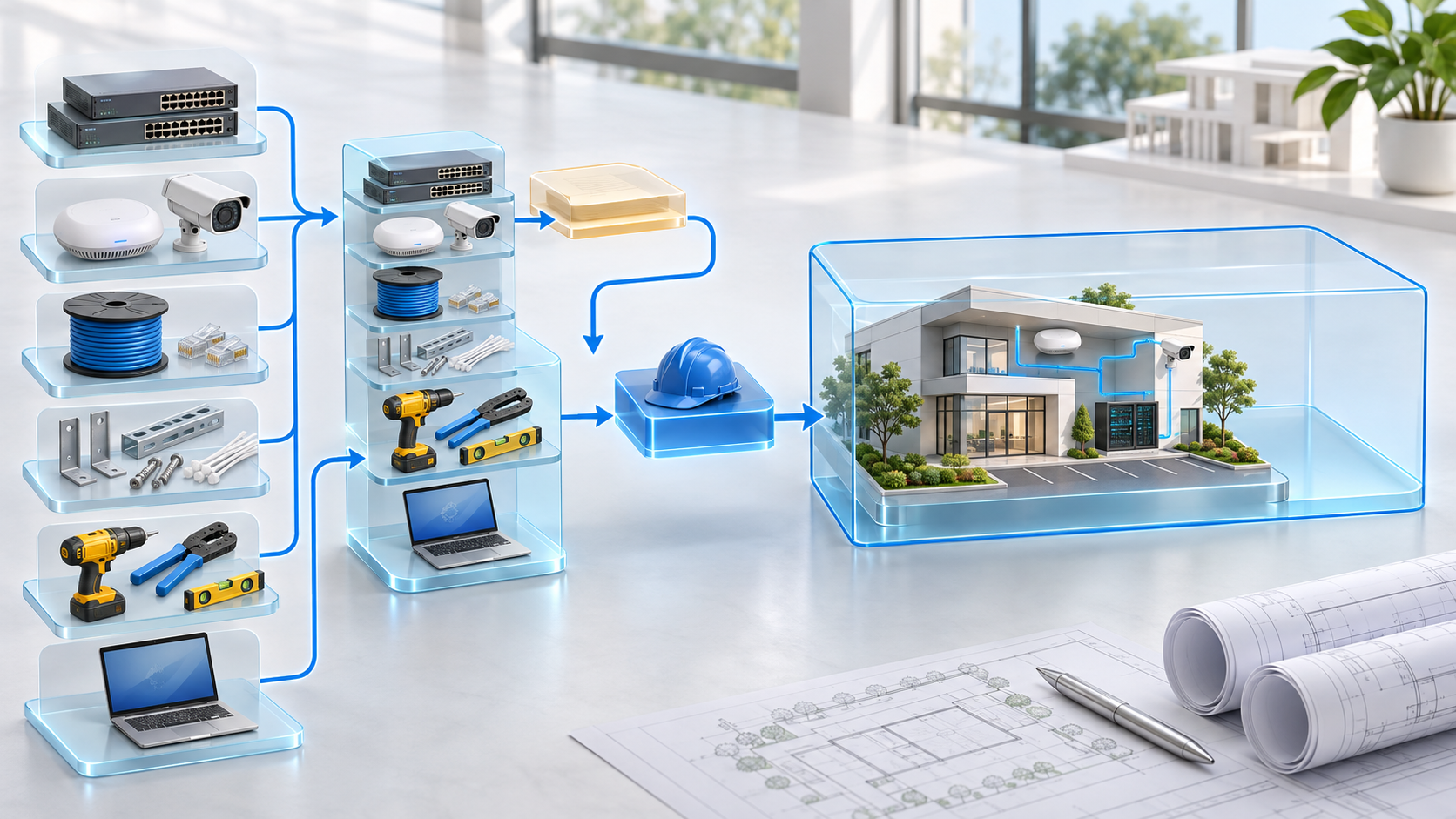
13 Separate Essential, Recommended, and Optional Work
When the estimate exceeds the available funding, classify the project components before making reductions.
| Scope Level | Meaning | Examples |
|---|---|---|
| Essential | Required for the system to operate safely and correctly | Core equipment, required cabling, power, configuration, testing |
| Recommended | Improves reliability, serviceability, documentation, or future readiness | UPS protection, organized rack, labeling, reserve switch ports, documentation |
| Optional | Provides additional capability that can be deferred without defeating the core project | Secondary displays, expanded coverage areas, cosmetic upgrades, nonessential integrations |
Phasing can be useful when the project has natural boundaries. For example:
- Build the rack, cabling backbone, and core switching first
- Add secondary access points in a later phase
- Install camera pathways now and add some cameras later
- Complete essential operational areas before optional common spaces
Phasing must be designed deliberately. Repeated mobilization, temporary work, purchasing changes, or rebuilding completed areas may make a poorly planned phased project more expensive overall.
14 Include Costs That Are Commonly Missed
Review the estimate for frequently omitted costs before treating the result as complete.
Possible omissions include:
- Shipping and delivery
- Taxes
- Permits and inspections
- Licensed-trade participation
- Lift or equipment rental
- Core drilling, conduit, trenching, or restoration
- Electrical circuits and outlets
- UPS systems and surge protection
- Rack accessories and cable management
- Patch cables, connectors, adapters, and mounting hardware
- Configuration and commissioning
- Testing and validation
- Documentation and labeling
- Training and operational handoff
- Travel and return visits
- After-hours or occupied-space work
- Data migration
- Disposal of old equipment
- Recurring subscriptions and licenses
- Support and maintenance
- Replacement spares
The estimator excludes financing, recurring subscriptions, maintenance, and change orders unless the user adds them as line items.
Consider whether recurring expenses should be shown separately from the one-time implementation budget. Combining several years of service costs with the installation total may be appropriate for lifecycle analysis, but it can obscure the immediate capital requirement if the distinction is not clear.
15 Compare Proposals by Scope, Not Only Price
Contractor proposals may organize costs differently. One may provide detailed labor and materials while another presents a single package price.
Before comparing totals, confirm that each proposal addresses:
- The same equipment quantities and models
- The same cable routes and termination counts
- The same mounting and installation work
- The same configuration and integration
- The same testing and acceptance process
- The same documentation and labeling
- The same permits, inspections, and licensed-trade responsibilities
- The same warranty and support expectations
- The same exclusions and client responsibilities
- The same tax and delivery treatment
A proposal may be lower because it uses different equipment, excludes configuration, assumes existing pathways, provides less testing, or transfers important responsibilities to the client.
Use the estimate as a scope-review tool rather than attempting to force every contractor’s internal pricing into an identical structure.
16 Update the Estimate as the Project Develops
A project estimate should change when better information becomes available.
Update it after:
- A site walkthrough
- Floor-plan review
- Final equipment selection
- Contractor or supplier pricing
- Discovery of pathway or power requirements
- Permit or inspection clarification
- Scope additions or removals
- Change orders
- Purchasing and installation
Maintain clear versions, such as:
- Concept estimate
- Budget estimate
- Quote comparison
- Approved project budget
- Committed cost
- Actual final cost
Do not overwrite the original estimate without preserving its assumptions. Comparing the initial plan with committed and actual costs provides useful information for future projects.
When a cost changes, record why. Possible reasons include:
- Scope change
- Incorrect quantity
- Price change
- Product substitution
- Site-condition discovery
- Additional labor
- Schedule change
- Originally omitted requirement
17 Use the Free Technology Project Cost Estimator
The free NaplesTechPro Technology Project Cost Estimator applies the planning method described in this guide.
Enter:
- The project name
- The planning sales-tax rate
- The contingency percentage
- The optional available budget
- Project notes and assumptions
- Each cost category
- The cost description
- The quantity
- The unit cost
- Whether the item is treated as taxable for planning
The estimator calculates:
- Every line-item total
- The complete base subtotal
- The taxable subtotal
- Estimated sales tax
- The contingency allowance
- The planned project total
- Budget remaining or budget overage
- Cost totals grouped by category
- Warnings for low contingency or missing implementation services
Build a Transparent Project Budget
Use the free Technology Project Cost Estimator to organize equipment, materials, labor, services, tax, contingency, and the available budget. The tool runs locally in your browser and does not upload the information you enter.
The estimator creates a planning estimate—not a contractor quote or bid. Confirm site conditions, applicable requirements, tax treatment, labor responsibilities, product availability, and current written pricing before authorizing work.
18 Complete the Final Project-Cost Review
Technology Project Cost Checklist
- Define the purpose and current maturity of the estimate.
- Describe the required project outcome.
- Document the included systems, locations, and quantities.
- Record important assumptions and exclusions.
- Separate equipment, materials, labor, and professional services.
- Include cabling, pathways, mounting, testing, and labeling.
- Include configuration, commissioning, and documentation.
- Use clear quantities and units.
- Use current researched prices or written quotes.
- Record the source and date of major prices.
- Confirm whether shipping and delivery are included.
- Review every taxable and non-taxable assumption.
- Verify tax treatment with an appropriate professional or authority.
- Select contingency according to project uncertainty and risk.
- Keep known required work outside the contingency allowance.
- Compare the planned total with the available budget.
- Separate essential, recommended, and optional work.
- Review commonly omitted implementation costs.
- Identify recurring subscriptions, licenses, and maintenance separately.
- Compare contractor proposals by scope and exclusions.
- Refresh pricing before purchase or authorization.
- Track approved changes, committed costs, and actual costs.
- Update the estimate whenever the scope or assumptions change.
A dependable technology-project estimate makes the scope, quantities, prices, tax assumptions, contingency, exclusions, and budget relationship visible. It does not begin and end with the purchase price of the primary equipment.
Start by defining the required outcome and complete cost structure. Calculate the base project, separate tax and contingency, compare the total with the available funding, and obtain current written pricing before authorization.
Use the NaplesTechPro Technology Project Cost Estimator to document those assumptions and create a clearer preliminary budget before equipment is purchased or project commitments are made.